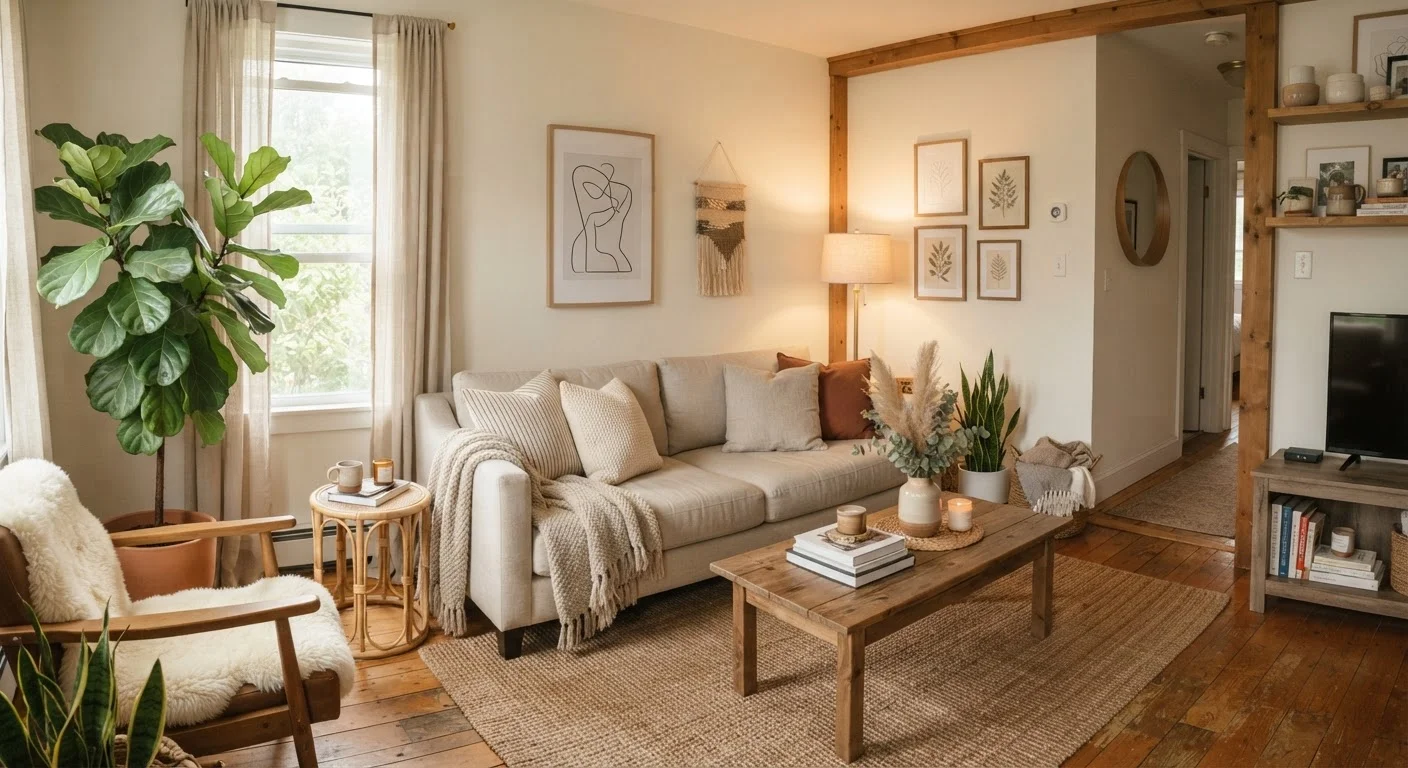
Why Budget Rooms So Often Look Unfinished
Spending less on décor doesn't automatically produce a room that looks inexpensive. What actually makes a space read as cheap is a set of recurring, fixable decisions: wrong scale, weak lighting, random color, and clutter masquerading as curation. Understanding these patterns is the foundation of affordable interior styling.
The mistakes below are among the most common in budget-decorated rooms. Each one has a clear cause - and a practical correction that rarely requires spending more money, just spending it differently. For a broader look at how these ideas fit together, the end-to-end budget decorating guide walks through the full planning process.
Avoid Decorating All at Once on a Tiny Budget
Rushing to fill every surface and wall when first moving in almost always produces a cluttered, incoherent look. It's better to live in a partially furnished space for a few weeks and add items deliberately. Patience consistently produces better results than urgency when decorating on a tight budget.
The Most Common Mistakes - and What to Do Instead
Work through these six patterns honestly. Most budget decorating problems stem from one or more of them, and correcting even two or three can visibly shift how a room feels.
Buying too many small, unrelated items to fill a space quickly.
Why it happens: Small décor is inexpensive individually, so it feels low-risk. Shoppers assume more items equal a more decorated room.
Hanging artwork too high or using pieces that are too small for the wall.
Why it happens: People default to eye-level hooks or whatever fits the available space, without accounting for furniture scale below.
Relying solely on overhead lighting, which flattens a room and reveals cheap finishes.
Why it happens: Overhead fixtures come standard with most rentals and homes, making them the default. Floor and table lamps feel like an extra expense.
Mixing too many colors and patterns without an organizing principle.
Why it happens: Budget shoppers buy items on sale or clearance individually, accumulating pieces that made sense alone but clash together.
Skipping textiles entirely or using only one type of fabric.
Why it happens: Textiles - rugs, throws, curtains, cushions - feel optional and add up quickly, so budget decorators often skip or minimize them.
Using curtains that are too short or too narrow for the window.
Why it happens: Shoppers match curtain size to window size rather than to room proportion, or buy the least expensive length available.
For a deeper look at how texture, color, and light work together as a system, see the low-cost trio that transforms any room. And if you're considering DIY artwork to fill wall space affordably, DIY wall art trade-offs covers the honest pros and cons.
Pulling It Together Without Overspending
Cheap Doesn't Have to Look Cheap
The goal isn't to spend more - it's to spend smarter. Every mistake below has a practical fix that costs little to nothing. Understanding why something looks off is more valuable than any individual purchase.
The single most useful habit in budget decorating is editing before buying. Walk through your current space and remove anything that doesn't earn its place - doesn't add color, texture, or function. Many rooms immediately improve with subtraction alone.
From there, prioritize in this order: lighting, a rug, curtains hung at ceiling height, and one or two substantial textiles. These elements do the most structural work in making a room feel intentional. Smaller decorative objects come last, chosen to complement what's already there rather than fill empty surfaces.
If you've absorbed these corrections and want to go further, styling approaches that work across different spaces covers repeatable strategies that apply room to room. And for separating decorating fact from fiction, common styling myths addresses the misconceptions that trip up even careful decorators.
Cost estimates and design conventions described here reflect general guidance from interior design educators and are not guarantees of specific outcomes. Results will vary based on your space, existing furnishings, and local product availability.