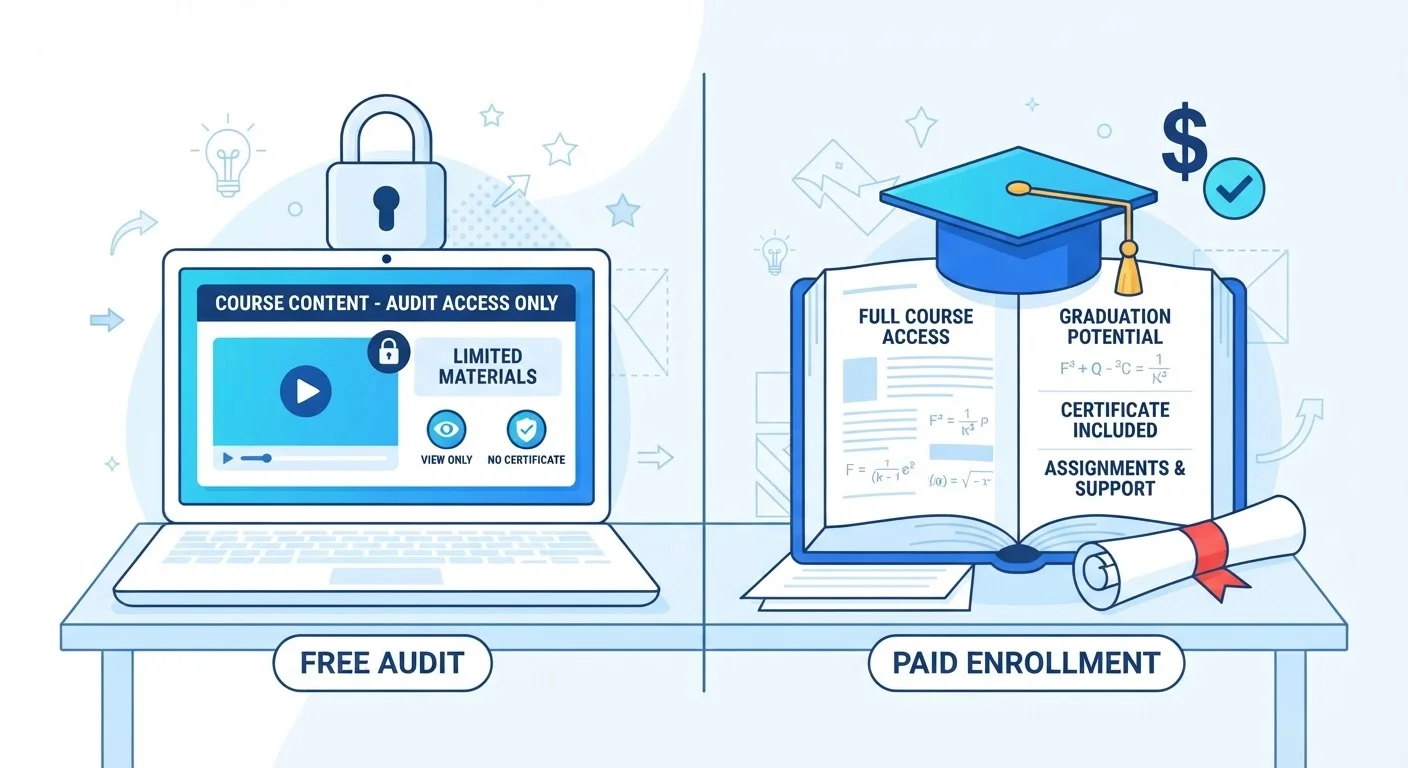
What Audit Mode Actually Gives You
When a platform offers audit mode, it means you can access a course's core content - typically video lectures, reading materials, and discussion forums - without paying. On platforms such as Coursera and edX, auditing is the default free pathway, and it exists because the institutions behind these courses want knowledge to be broadly accessible.
What you don't get in audit mode is equally important to understand. Graded quizzes, peer-reviewed assignments, instructor feedback, and the shareable certificate at the end are all locked behind a payment. On some platforms, audit access expires after a set period - Coursera, for example, limits auditors on some courses, while others remain open indefinitely. The rules differ by platform, course, and sometimes even by semester, so it's worth reading the enrollment details carefully before you start. See our overview of MOOCs, open courseware, and free certificates for a broader look at how these distinctions play out across the free-learning landscape.
| Criterion | Audit Mode | Full Enrollment |
|---|---|---|
| Cost | Free | Paid (financial aid often available) |
| Video lectures & readings | Included | Included |
| Graded assignments | Not accessible | Fully accessible |
| Shareable certificate | Not awarded | Awarded on completion |
| Peer review & feedback | Limited or none | Included on most platforms |
| Access duration | Varies; may expire | Typically lifetime access |
| Accountability structure | Self-directed only | Deadlines and grades included |
| Best for | Exploration, supplemental learning | Career credentials, structured goals |
What Full Enrollment Unlocks
Paying for full enrollment - or qualifying for financial aid to cover the cost - gives you the complete course experience. That includes all graded assessments, the ability to earn a certificate, and often access to peer review communities where feedback is part of the learning process. Some programs also include direct engagement with teaching assistants or mentors.
The certificate itself matters most when you're targeting a specific career outcome. A verifiable, platform-issued certificate that names the institution and the competencies assessed carries more weight in a job application or professional profile than a self-reported audit. For learners building toward a career pivot or promotion, that documentation can be the deciding factor. Platforms like Coursera and edX both offer need-based financial aid that can reduce the cost of full enrollment substantially - in some cases to zero - making this option more accessible than it might first appear. Our Student Money Tips hub covers financial aid strategies in more depth for learners on a tight budget.
How to Decide Which Path Fits Your Goal
The decision comes down to three practical questions: Why are you taking this course? Do you need proof of completion? And how do you learn best?
If your goal is intellectual curiosity, reinforcing skills you already use, or testing whether a subject is worth deeper study, audit mode is a sensible starting point. You risk nothing financially, and many motivated learners complete entire course sequences this way. The risk of audit mode is motivational - without assignments and deadlines, dropout rates are notably higher. If that pattern sounds familiar, our article on why learners sign up for everything and finish nothing offers practical strategies for building follow-through habits.
If your goal ties to a professional credential, a degree pathway, or a portfolio you'll show employers, the structure and documentation of full enrollment is generally worth pursuing - especially when financial aid is available. It's also worth noting that choosing free learning paths isn't only a budget decision; many learners audit out of preference, not necessity.
For a practical comparison of which major platforms handle audit access most generously, see our breakdown of how LinkedIn Learning, Coursera, and edX actually differ.