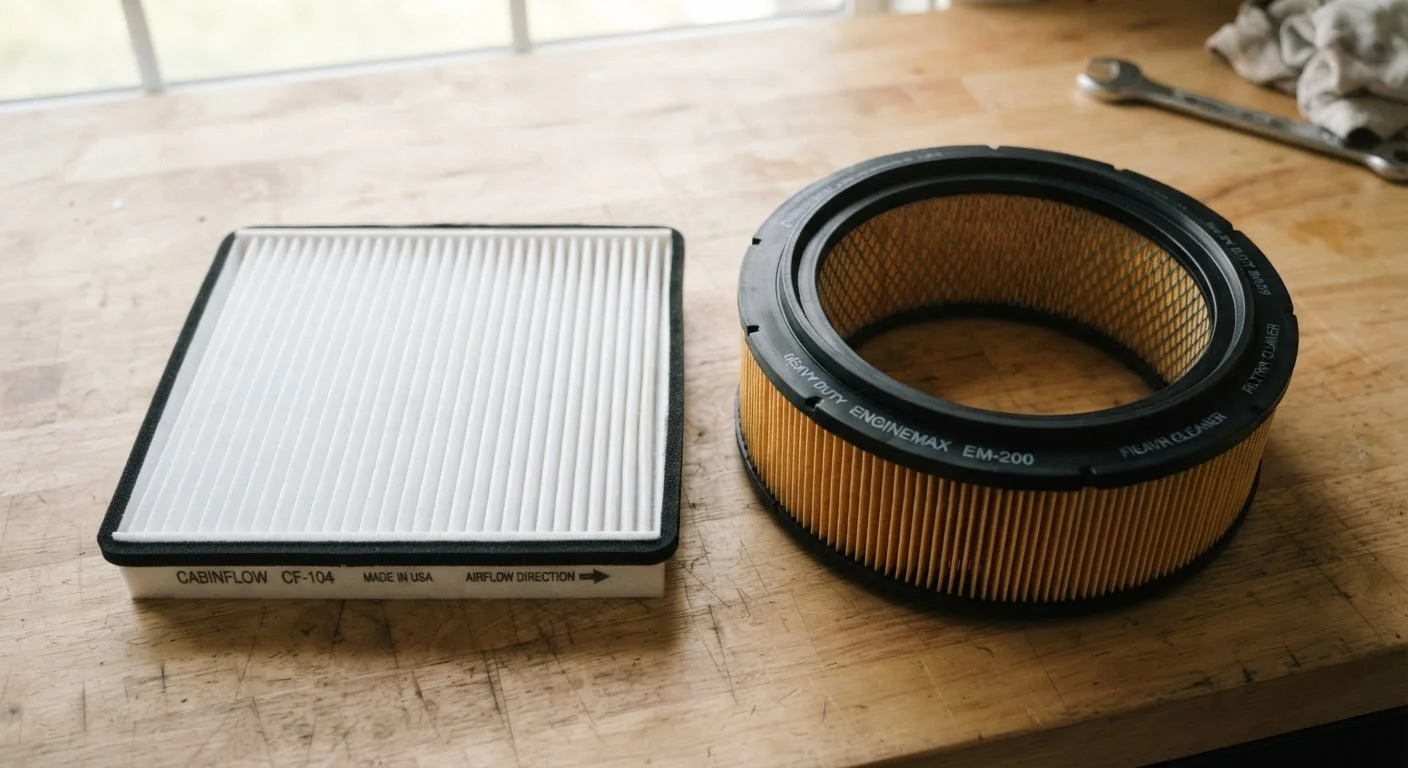
What Each Filter Actually Does
Your vehicle has two separate air filtration systems that serve completely unrelated purposes - and mixing them up is a surprisingly common source of confusion at the service counter.
The cabin air filter sits in the HVAC system, typically behind the glove box or under the dashboard. Its sole job is to filter the air that flows into the passenger compartment through your heating, ventilation, and air conditioning system. It traps pollen, dust, mold spores, and other airborne particles before they reach you and your passengers.
The engine air filter lives in the engine bay inside an airbox connected to the intake system. It filters the outside air drawn into the engine for combustion. Without it, grit, insects, and road dust would enter the cylinders and gradually wear down internal components. A clean engine filter ensures the engine receives an adequate volume of clean air - a requirement for efficient fuel combustion.
In short: one protects your lungs, the other protects your engine. Both matter, but for entirely different reasons.
| Criterion | Cabin Air Filter | Engine Air Filter |
|---|---|---|
| Primary function | Filters passenger compartment air | Filters engine intake air |
| Location | Behind glove box or dashboard | Engine bay airbox |
| Typical replacement interval | 12,000-15,000 miles | 15,000-30,000 miles |
| DIY difficulty | Generally easy (10-15 min) | Generally easy (10-20 min) |
| Symptom when clogged | Weak HVAC airflow, musty odors | Reduced fuel economy, sluggish throttle |
| What it protects | Occupant air quality | Engine internals and efficiency |
Replacement Intervals and Warning Signs
Neither filter lasts forever, and the right replacement schedule depends on your driving conditions as much as mileage.
Engine air filter: Most manufacturers recommend inspection around every 15,000 miles and replacement roughly every 15,000-30,000 miles. Dusty environments - construction zones, unpaved roads, dry regions - can cut that interval significantly. Signs it's overdue include a noticeable drop in fuel economy, sluggish throttle response, or a visibly gray and debris-clogged filter element when inspected.
Cabin air filter: A common guideline is replacement every 12,000-15,000 miles, though high-pollen or high-dust areas may warrant more frequent changes. Symptoms of a clogged cabin filter include reduced airflow from the vents even at high fan settings, musty or stale smells when the HVAC runs, and increased noise from the blower motor working harder to push air through a blocked filter.
Always cross-reference your vehicle's owner's manual for the manufacturer's specific recommendation - intervals vary meaningfully across makes and models.
DIY Difficulty and What to Expect
Both filters are among the more accessible maintenance tasks a vehicle owner can tackle without specialized equipment.
Cabin air filter replacement typically involves opening the glove box, releasing a few clips or retaining tabs, sliding out the old filter, and inserting the new one in the correct orientation. For most modern vehicles, the whole process takes under 15 minutes. Some older or European models route the filter under the dashboard or beneath the hood near the windshield base, which can add a few extra steps.
Engine air filter replacement usually means opening the airbox housing - typically secured by clips or a few screws - removing the old filter, wiping out any debris from the housing, and seating the new filter properly before closing the box. This also takes roughly 10-20 minutes on most vehicles. It's worth noting that on some turbocharged or performance-tuned engines, the intake layout can be more complex; when in doubt, have a qualified mechanic handle it.
If you're new to either task, your vehicle's owner's manual or a model-specific resource can walk you through the exact steps. A visual inspection at each oil change is a practical habit that keeps both filters from going unnoticed for too long.