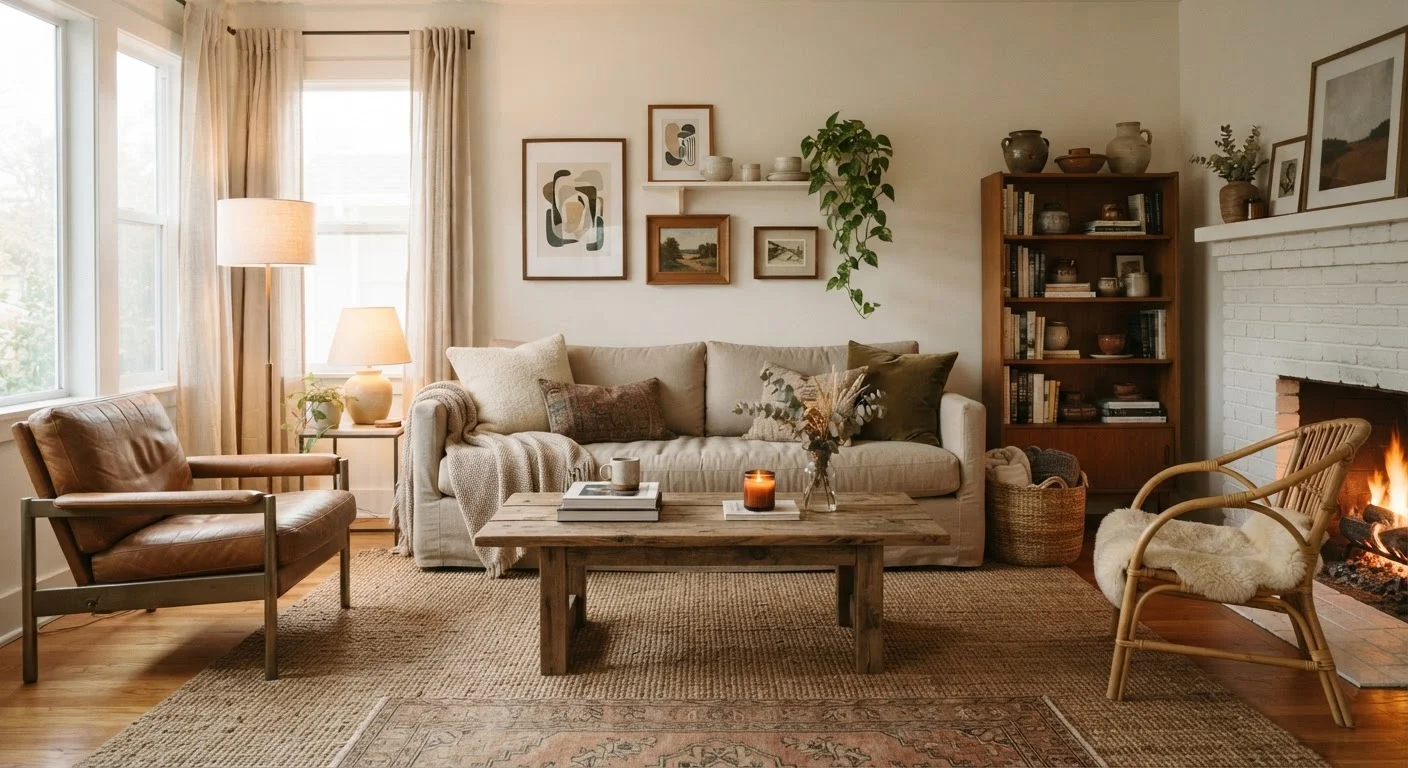
Why Consistent Approaches Beat One-Off Purchases
Budget decorating fails most often not from a lack of money, but from a lack of method. Buying individual items without a guiding framework leads to rooms that feel disjointed regardless of how much was spent. The good news: the decorating principles that work in a designer's studio apply equally in a studio apartment - they just cost less to execute when applied deliberately.
Before spending anything, audit what you already have. Our room-by-room checklist is a practical tool for spotting styling opportunities before opening your wallet. And if you're just getting started, our guide to styling your first apartment on a shoestring lays out a clear starting framework.
Core Practices That Work Across Any Space
The following approaches are recommended consistently by interior design educators and experienced DIY decorators alike. They work in rental apartments, owned homes, small rooms, and large ones.
Commit to a three-color palette and repeat it throughout the room.
Color repetition is one of the simplest ways to make a room feel intentional and cohesive. Without it, even expensive furnishings look random. A three-color limit forces discipline and prevents the visual noise that comes from too many competing tones.
Layer at least three textures in every seating or sleeping area.
Texture creates the tactile richness that makes a room feel designed rather than merely furnished. Flat, uniform surfaces - even in good colors - read as incomplete. Mixing matte, woven, and soft finishes adds visual depth that furniture alone can't achieve.
Prioritize warm, layered lighting over relying on a single overhead fixture.
Overhead lighting alone flattens a room and makes it feel institutional. Adding table lamps, floor lamps, or candles at varying heights creates pools of warmth that shift how a space is perceived - often more effectively than any furniture upgrade.
Edit ruthlessly before adding anything new.
Overcrowded rooms look cheap regardless of the quality of individual items. Removing clutter and excess decor is free and often has the most immediate visual impact. Most rooms benefit from having 20-30% fewer objects on display.
Use mirrors deliberately to expand perceived space and bounce light.
Mirrors are one of the most cost-effective tools in decorating because they serve two purposes simultaneously: reflecting light and creating the illusion of depth. Placed opposite a window, even a modestly sized mirror can make a room feel significantly larger.
Anchor seating areas with a rug sized correctly for the furniture.
An undersized rug is one of the most common mistakes in budget decorating - it makes furniture look ungrounded and spaces feel smaller. A correctly sized rug unifies a seating group and gives a room a finished quality that smaller accent rugs cannot replicate.
Quick Actions You Can Take This Week
Not every improvement requires planning or spending. Some of the highest-impact changes involve rearranging, editing, or reusing what's already in your home. Start here:
For a deeper look at how texture, color, and light can transform a room for very little money, see our dedicated guide on the low-cost trio that transforms any room.
Avoiding the Traps That Stall Progress
Even with a solid plan, a few common missteps consistently derail budget decorating efforts. Buying too many small items without restraint creates visual clutter that no amount of styling can fix. Ignoring scale - placing furniture that's too small for a wall or too large for a walkway - makes a room feel unplanned. And chasing trends rather than building a personal, consistent aesthetic means rooms feel dated faster, which leads to more spending over time.
For a direct look at what common advice gets wrong, our article on affordable styling myths that keep rooms looking unfinished is worth reading before making any significant purchases. If you're weighing where to source furniture, the comparison of thrift store finds versus flat-pack furniture breaks down the real trade-offs clearly.
For renters navigating what they can and can't change, see our guide on how tenancy status should shape your décor choices. And if you're ready for a full room overhaul, the step-by-step room decorating approach walks through planning to final touches in a structured way.