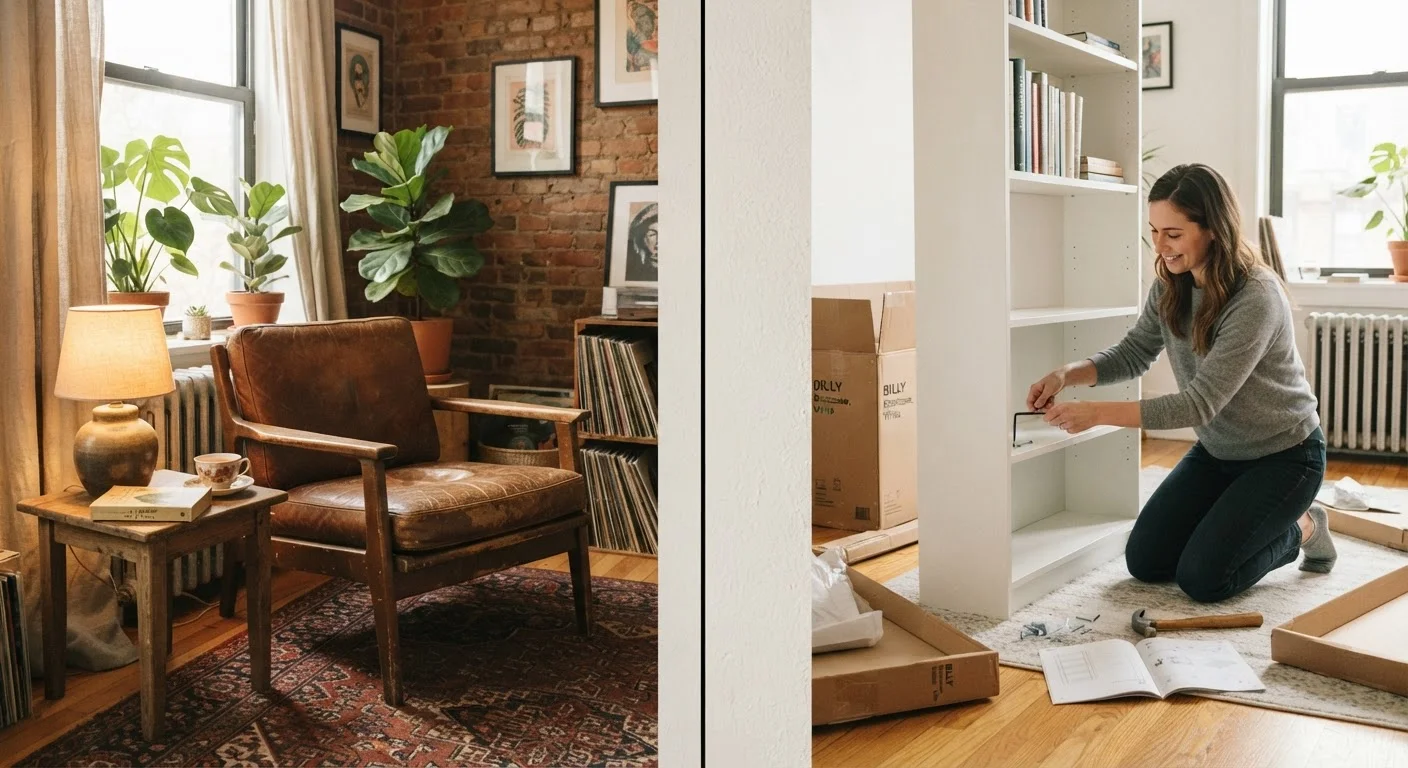
The Real Cost Comparison
Price is rarely as simple as sticker cost. At a thrift store, a solid-wood dresser might run $30-$80 depending on your area and the store's pricing policy - but factor in any refinishing supplies, hardware replacements, and the time spent across multiple visits, and your actual outlay rises. At a flat-pack retailer, a comparable new dresser may cost $120-$200, but what you see is largely what you pay, and you know the dimensions before you leave home.
The gap narrows or widens depending on what you're buying. Thrift stores tend to offer stronger value on large, solid-construction items like bookshelves, side tables, and upholstered chairs - pieces where older manufacturing methods used more durable materials. Flat-pack tends to be more competitive on highly functional, small-footprint items like storage units, bed frames, and desks, where precision sizing matters.
For a practical framework on setting your overall décor budget before you start shopping either way, see our end-to-end budget decorating guide.
| Criterion | Thrift Store Finds | Flat-Pack Furniture |
|---|---|---|
| Typical price range (mid-size item) | $20-$100+ | $80-$250+ |
| Quality consistency | Highly variable | Predictable within price tier |
| Style variety | Eclectic, era-spanning | Mostly contemporary/neutral |
| Effort to acquire | High - repeated visits needed | Low - order online or in-store |
| Dimensions known upfront | Rarely | Always |
| Environmental impact | Lower - reuses existing items | Higher - new manufacturing |
| Assembly required | Possible restoration work | Yes - self-assembly |
| Best for renters who move often | Moderate | Strong |
Quality, Durability, and What You're Actually Getting
Flat-pack furniture is often made from medium-density fibreboard (MDF) or particleboard - engineered wood products that are consistent and affordable but can be vulnerable to moisture and repeated assembly-disassembly. Entry-level flat-pack may show wear within three to five years under regular use, though mid-range lines using thicker board and metal hardware tend to hold up longer.
Thrift store furniture spans a wide spectrum. A piece from the 1970s or earlier may be solid hardwood with dovetail joints - construction that genuinely outlasts most flat-pack. But it could also be a veneer-over-particleboard piece from the 1990s that's already delaminating. The rule at thrift stores: inspect every joint, drawer slide, and surface before buying. Wobble, soft spots, and swelling around edges are signs of structural compromise that's difficult or costly to fix.
~45%
US adults who have shopped secondhand for home goods
According to ThredUp's 2023 Resale Report, nearly half of US consumers have purchased secondhand items including home furnishings.
3-5 years
Typical lifespan of entry-level flat-pack furniture
Consumer product longevity assessments generally place budget particleboard furniture in the three-to-five-year range under everyday household use.
10M+
Tons of furniture discarded annually in the US
The US Environmental Protection Agency estimates that furniture represents a substantial share of municipal solid waste each year, underscoring the environmental case for reuse.
If you need a room-by-room framework before deciding where each type of piece fits, the budget decorator's room-by-room checklist can help you prioritise where to spend and where to save.
Style, Flexibility, and the Effort Trade-Off
Thrift store shopping rewards flexibility. If you're open to painting, reupholstering, or mixing eras, secondhand pieces can create genuinely distinctive rooms. The trade-off is unpredictability: you may visit several stores over weeks before finding the right piece in the right condition.
Flat-pack furniture offers the opposite: predictability. You can browse online, check dimensions against your floor plan, and order with confidence. The aesthetic is more uniform - most flat-pack lines lean toward contemporary or Scandinavian-influenced styles - so achieving a curated, layered look often requires accessorising or mixing in secondhand accent pieces.
A practical hybrid approach: use flat-pack for foundational, functional pieces (beds, desks, shelving) where size precision matters, and fill in with thrift store finds for personality - an armchair, a side table, framed art. This is one of the repeatable strategies covered in styling on a budget approaches that consistently work. For those starting entirely from scratch, our first apartment styling guide walks through how to layer both sources effectively.