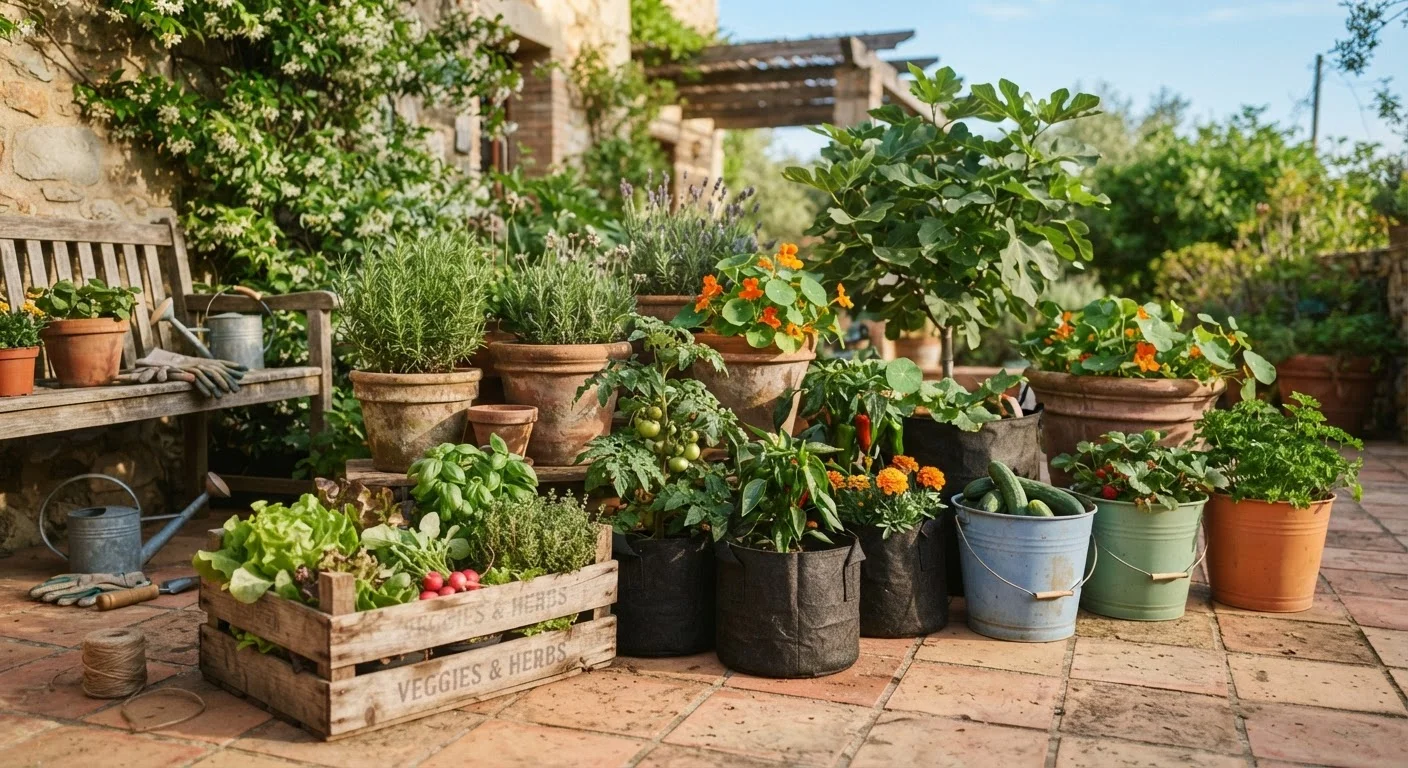
Why the Container Choice Actually Matters
It's tempting to treat the pot as an afterthought - grab whatever's available and fill it with soil. But the vessel you use influences root health, moisture retention, drainage, and even how much you spend on water and replacement plants over a season. Getting this decision right up front prevents dead plants and wasted money later.
If you're starting a garden from zero, containers are often the first real cost you face. Understanding the trade-offs before you buy - or before you raid the garage - helps you make choices that hold up through the growing season.
The four factors that matter most when evaluating any container are: drainage, material porosity, volume relative to what you're growing, and durability over time. Every container type performs differently across these.
Repurposed Containers: Free and Functional - With Caveats
Five-gallon buckets, colanders, wooden crates, old coolers, and even tin cans can all work as planters. The appeal is obvious: cost is near zero. The caveats are worth knowing.
Food-safe matters. Containers that previously held chemicals, motor oil, or non-food-grade materials can leach harmful residues into soil and then into edible plants. Stick to food-grade buckets (often marked with a recycling symbol and resin code 2 - HDPE) for anything you plan to eat. For ornamentals, the risk threshold is lower but still worth considering.
Drainage must be added. Most repurposed containers have no drainage holes. Drilling several holes in the base takes minutes and is essential - waterlogged roots rot quickly. Without drainage, no amount of good potting mix saves a plant.
Wood needs airflow. Wooden crates work well but break down faster when soil stays persistently wet against the wood. Lining the interior with landscape fabric while leaving the base open helps extend the lifespan and reduces direct soil contact with the wood.
For a deeper look at how container choice interacts with watering frequency, see watering smarter strategies - the porosity of your container changes how often you need to intervene.
Pros and Cons of the Main Container Types
Here's a practical breakdown of the most common options budget gardeners reach for:
Low or zero cost using repurposed household items
Five-gallon buckets, wooden crates, and old colanders can be repurposed as effective planters with minimal preparation. This approach keeps startup costs close to zero for gardeners who already have suitable items on hand.
Fabric bags promote healthier root systems
Air pruning through porous fabric walls prevents roots from circling and becoming bound, which typically leads to stronger, more productive plants over the course of a season.
Containers offer mobility and flexibility
Unlike in-ground or raised bed planting, containers can be repositioned to chase sunlight, moved indoors before frost, or rearranged to suit the space - a significant advantage for renters or those with irregular layouts.
Easier to control soil quality precisely
Container gardening lets you fill each vessel with a mix suited to specific plants, bypassing the need to amend poor native soil - which can be expensive and time-consuming.
Works in spaces with no ground access
Patios, balconies, driveways, and rooftops all become usable growing space with containers, making food production accessible to renters and urban dwellers who lack garden beds.
Fabric and porous containers dry out quickly
Air circulation through porous walls accelerates moisture loss, which can mean daily watering during summer heat. This increases both time investment and water costs over a growing season.
Containers limit root volume and plant size
Even a large container restricts root spread compared to in-ground growing. Larger fruiting plants like sprawling squash or full-sized fruit trees are not well suited to container constraints.
Repurposed containers require safety and drainage checks
Not every household item is safe for growing edibles - chemical residues in non-food-grade containers can transfer to soil. Every repurposed container also needs drainage holes drilled before use.
Containers need more frequent feeding
Nutrients leach out of container soil faster than in-ground soil because watering washes them through the drainage holes. Container plants generally need more regular fertilizing than in-ground equivalents.
Thin plastic degrades under prolonged UV exposure
Budget plastic pots left outdoors in full sun often become brittle and crack within one to two seasons. Replacing them repeatedly can offset the initial cost savings.
Plastic containers occupy the middle ground - affordable, lightweight, and widely available. Their main weakness outdoors is UV degradation; thin plastic becomes brittle after a season or two of direct sun exposure. Thicker-walled plastic pots last considerably longer. Terracotta is porous and breathes well, which suits Mediterranean herbs and succulents, but it's heavier to move and breaks more easily.
If you're gardening on a balcony where weight is a constraint, this trade-off is especially significant. Our guide to balcony gardening covers weight limits and wind exposure in more detail.
Fabric Grow Bags: Worth the Small Upfront Cost?
Fabric grow bags have become a popular choice among budget gardeners because they're inexpensive, foldable for storage, and genuinely good for root health. The porous fabric allows air to reach the root zone - a process called air pruning - which prevents roots from circling and becoming root-bound, a common problem in solid containers.
Air Pruning: What It Means in Practice
When roots reach the air at the edge of a fabric container, the root tip desiccates and stops elongating - a process called air pruning. The plant responds by producing more lateral root branches, resulting in a denser, more efficient root system. This is why plants in fabric bags often outperform those in same-sized solid containers, even though the bag itself costs less than a ceramic or thick plastic pot.
The trade-off is water. Fabric bags lose moisture faster than plastic or ceramic because air circulates through all sides. In hot, dry climates or during summer heat, you may need to water daily. That added frequency is a real cost in time and, depending on your water rates, in money. Pairing fabric bags with a quality potting mix - rather than a cheap, fast-draining mix - helps retain some moisture. Our piece on why cheap potting mix costs more in the long run explains what to look for on the label.
Fabric bags generally last two to four seasons with reasonable care. Rinsing and air-drying them between uses helps prevent mold and extends lifespan.
5-10 gal
Minimum volume for productive tomato containers
Horticultural extension guidance generally recommends at least 5 gallons for determinate tomatoes and 10 gallons or more for indeterminate varieties to support adequate root development.
2-4x
Faster drying rate in fabric vs. plastic containers
Garden trial observations suggest fabric grow bags can dry out roughly two to four times faster than equivalent-sized solid containers in warm, sunny conditions, requiring more frequent irrigation.
Sizing and Matching Containers to Plants
An undersized container is one of the most common reasons container plants underperform. Roots that run out of space stop growing, which limits the plant's ability to take up water and nutrients. The result looks like nutrient deficiency or drought stress even when neither is the cause.
General sizing guidelines: leafy greens and herbs typically do fine in 6-10 inch pots or 1-3 gallon bags. Tomatoes, peppers, and cucumbers need at least 5 gallons - and 10 gallons produces noticeably better yields for indeterminate tomato varieties. Root vegetables like carrots need depth, not just volume - a narrow but deep container outperforms a wide, shallow one.
Bigger isn't always better, either. Large containers filled with wet potting mix are heavy, harder to move, and can stay soggy around the root zone when a small plant doesn't yet fill the volume. Starting with an appropriately sized container and repotting up as the plant grows is a sensible, cost-conscious approach. For those comparing container growing to other options, raised beds vs. in-ground planting covers where containers sit in the wider picture.