Why Home Training Works
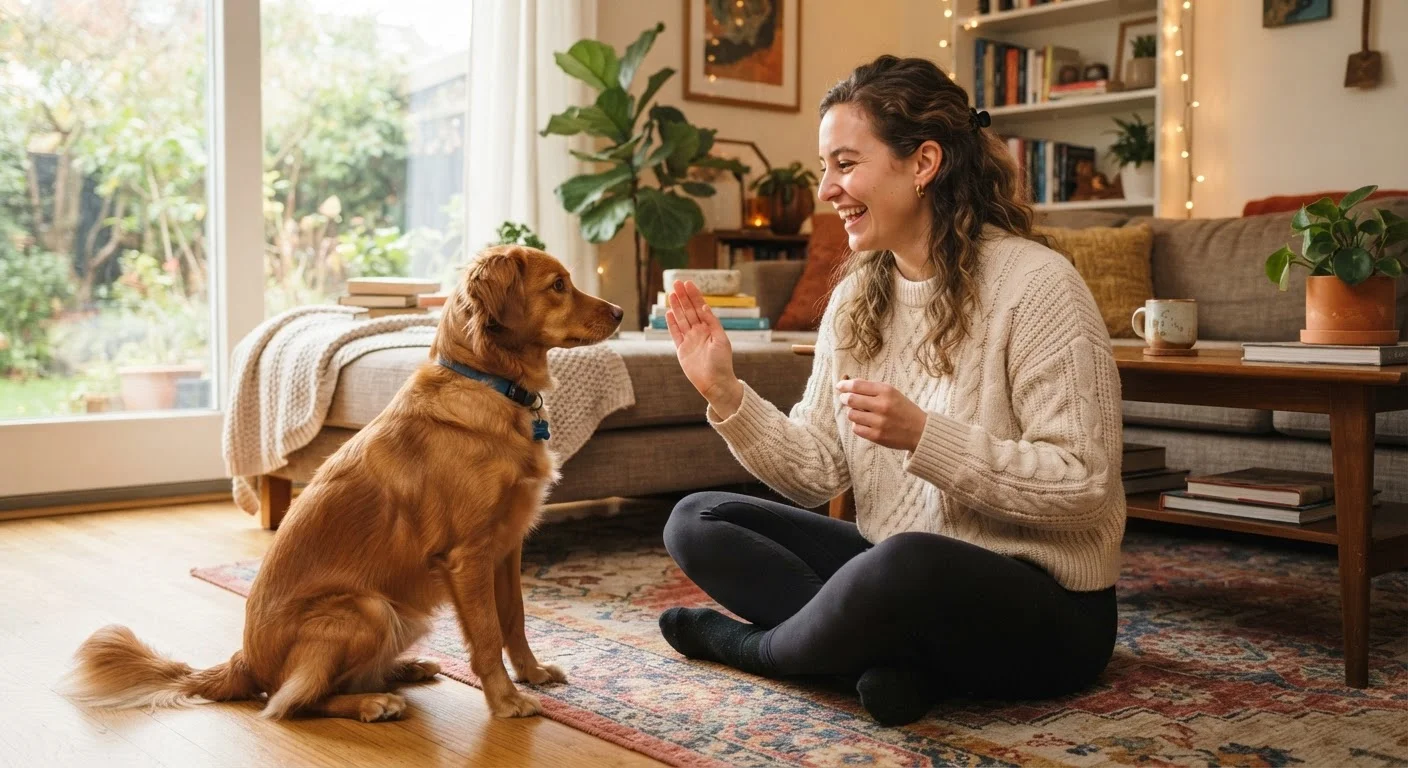
Professional dog trainers are valuable, but they're not the only path to a well-mannered dog. Home training gives you something classes can't replicate: a dog that learns the rules in the exact environment where those rules matter most. Your living room, backyard, and daily routines become the classroom.
Dogs generalise behaviour better when taught across real contexts rather than a single training facility. That means the sit you practise before meals at home is more durable than one rehearsed only at a weekend class. For first-time pet owners, starting at home also lets you build confidence alongside your dog - no pressure, no audience.
Before diving in, check out the preparation checklist for new pet owners to set up your space and mindset correctly from day one.
The Science of Positive Reinforcement
Reward-based training isn't just a trend - it's grounded in decades of animal behaviour research. When a dog performs a behaviour and receives an immediate, meaningful reward, the brain reinforces the neural pathway associated with that action. Over repetitions, the behaviour becomes the dog's default response to a given cue.
Punishment-based methods, by contrast, can suppress behaviour without teaching an alternative, and may erode the trust that makes training possible. For a deeper look at the mechanisms involved, our guide to positive reinforcement science breaks down the research in plain language.
Keep your treat pouch stocked before every session, not during - fumbling for rewards adds a delay that weakens the reinforcement signal. Timing is everything in dog training.
Research in operant conditioning shows that rewards delivered within one to two seconds of a behaviour have significantly stronger reinforcing effects than delayed rewards.
Train your dog when they're slightly hungry, not immediately after a meal. A mildly hungry dog is a focused dog - motivation is your most powerful training tool.
Food motivation is a core driver of reward-based learning; satiated dogs are simply less interested in working for treats, which slows skill acquisition.
Rewards don't have to be food every time. Praise, play, and access to something the dog wants (a door opening, a toy tossed) all qualify - and rotating reward types keeps motivation high without overloading your pup on treats.
Core Commands Every Dog Needs
Start with the five commands that have the greatest day-to-day safety and quality-of-life impact:
- Sit - the gateway cue; establishes impulse control at doorways, mealtimes, and greetings.
- Stay - teaches your dog to hold position until released, critical near roads or open doors.
- Come - a reliable recall is the single most important safety skill a dog can have.
- Leave it - redirects attention away from hazards, dropped food, or other animals.
- Down - a calm default position useful in public spaces and during visitors.
For step-by-step walkthroughs of sit, stay, and come using nothing but patience and household treats, see our dedicated guide on teaching the three essential commands.
Practice each command in short bursts - two to five minutes per cue - across three to five sessions daily. End every session on a successful repetition so your dog associates training with a win.
Managing Problem Behaviours
Jumping, barking, leash pulling, and chewing are among the most common complaints from dog owners - and nearly all of them stem from unmet needs or inadvertent reinforcement. The fastest fix is almost always prevention plus redirection, not punishment.
Jumping Up
Turn away and withhold all attention the moment four paws leave the ground. Reward calm greetings with four paws down. Consistency across every household member is non-negotiable - one person allowing the jump undoes everyone else's work.
Excessive Barking
Identify the trigger first: boredom, alerting, anxiety, or demand barking each require a different response. For alert barkers, a "quiet" cue paired with a brief timeout from attention is effective. For anxious barking, consult a veterinarian or certified behaviourist, as this may indicate a welfare concern beyond a training fix.
Leash Pulling
Stop moving the moment the leash goes taut. Resume only when there's slack. It's slow initially but teaches the dog that pulling never produces forward movement - and it costs nothing beyond time.
When to Involve a Professional
Aggression toward people or other animals, extreme fear responses, and resource guarding are behaviours that carry real safety risks and typically require a certified applied animal behaviourist or veterinary behaviourist - not just at-home training adjustments. Do not attempt to "power through" these behaviours alone. Contact your veterinarian as a first step.
Training on a Budget
Great training requires consistency and patience far more than it requires equipment or paid programmes. Here's how to keep costs minimal without cutting corners on quality:
- Use household treats wisely. Small, soft pieces of cooked chicken, plain rice cakes, or carrot sticks work as well as commercial training treats for most dogs. Keep pieces tiny - pea-sized - so your dog stays motivated without filling up.
- Tap free digital resources. Public libraries, YouTube channels run by certified applied animal behaviourists, and university extension programmes offer solid, research-backed guidance at no cost.
- Consider group classes as a complement, not a requirement. Our article on group classes vs. at-home training lays out exactly when the investment makes sense.
For a fuller breakdown of zero- and low-cost training strategies, visit our guide on pet training on a tight budget. More general cost-saving pet care ideas live in our Budget Pet Care hub.
Building Consistency Over Time
Training is not a phase - it's a lifestyle. Dogs thrive on predictable rules and routines, and behaviour maintained through daily life is far more durable than behaviour drilled in isolation.
Embed cues into ordinary moments: ask for a sit before the food bowl goes down, a stay before the front door opens, a come before leashing up. These micro-sessions cost no extra time and build a vocabulary your dog relies on across years, not just weeks.
Track small wins. When jumping drops from ten times per greeting to twice, that's progress worth noting. Setbacks - a regression during a move, a new baby, a change in schedule - are normal and temporary. Return to basics, increase reward value briefly, and rebuild from a foundation of success rather than frustration.
For ongoing health context that supports good behaviour (adequate exercise, mental stimulation, pain-free movement), explore the Pet Health Basics hub.
This article is for general informational and educational purposes only. It is not a substitute for guidance from a certified professional dog trainer or veterinary behaviourist. If your dog displays aggression, severe anxiety, or any behaviour that poses a safety risk, consult a qualified professional before attempting to address it at home.