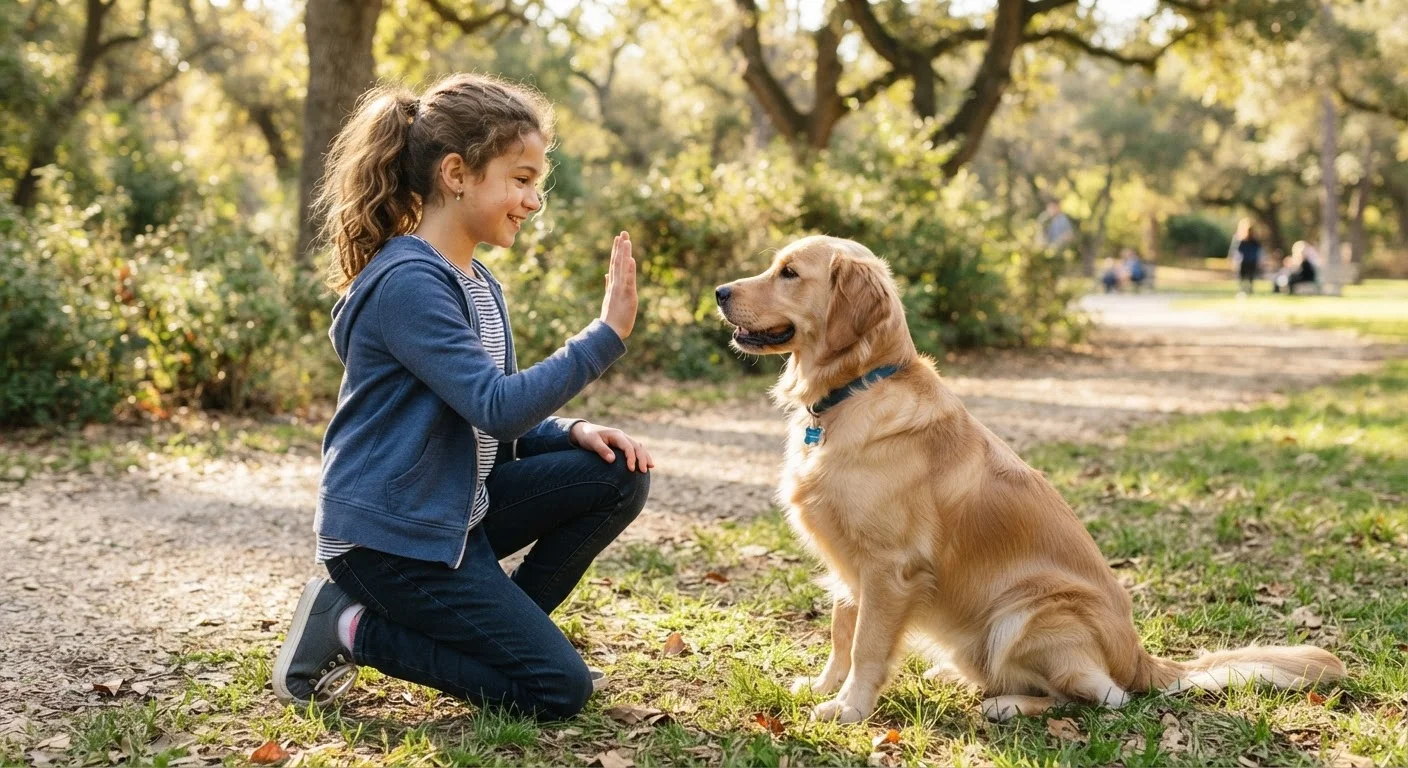
Why Training Signals Matter
Every time you communicate with your pet, you're using a signal - whether you realize it or not. The way you say a word, the position of your hand, or a short whistle all carry meaning your animal can learn to recognize and respond to consistently. Building a clear, deliberate signal system is one of the most effective - and completely free - foundations of pet training.
Different signal types serve different situations. A sharp whistle carries across a noisy dog park where your voice gets lost. A silent hand gesture works perfectly when your dog is across the room and a raised voice might startle a nervous animal. Understanding when each type excels helps you build a reliable communication toolkit without spending a cent. For a deeper look at why consistency and reward-based methods power this approach, see our piece on positive reinforcement and animal behaviour.
Hand signal
A deliberate visual gesture used by a trainer to communicate a specific behaviour request to an animal. Hand signals are especially useful in noisy environments or with hearing-impaired pets.
Voice cue
A spoken word or short phrase consistently used to prompt a specific behaviour. The tone and timing of delivery matter as much as the word itself.
Whistle signal
A patterned sound produced by a whistle - or the lips - used to communicate commands at a distance. Common in recall and field training.
Recall
The trained behaviour of an animal returning to its owner on cue. A reliable recall is one of the most important safety behaviours for any dog.
Bridging stimulus
A neutral signal - such as a click or a whistle tone - that marks the exact moment a correct behaviour occurs, bridging the gap between the action and the reward.
Conditioned reinforcer
A signal (like a clicker sound or a whistle blast) that an animal has learned to associate with a reward. Over time it takes on motivating power of its own.
Common Hand Signals and What They Mean
Hand signals are especially valuable for dogs with hearing loss, in loud environments, or as a complement to verbal cues. Research in animal behaviour consistently shows that many dogs pick up visual cues at least as quickly as auditory ones. The key is choosing a distinct gesture for each behaviour and using it every single time.
| Cost to get started | $0 - voice and hands are free |
| Ideal signal length (voice cues) | 1-2 syllables (Widely recommended in applied animal behaviour literature) |
| Works for cats? | Yes - short cues and hand targets work well |
| Whistle range advantage | Carries further than a human voice in open spaces |
| Key consistency rule | Same signal, every time, from every household member |
| Best time to introduce signals | Short sessions of 3-5 minutes, 2-3 times daily (Based on general animal behaviour training guidance) |
| Behaviour | Common Hand Signal | Tips for Consistency |
|---|---|---|
| Sit | Palm facing up, arm raised from hip to chest | Keep movement smooth and identical each time |
| Down / Lie Down | Palm facing down, arm lowered toward floor | Pair with a calm, low-pitched voice cue initially |
| Stay | Open palm pushed forward, like a stop sign | Hold the signal until you release the animal |
| Come / Recall | Arm extended, then swept across your chest | Always reward a recall - never punish a slow return |
| Leave It | Closed fist held out, then opened flat | Practice first with low-value items |
You can adapt any gesture to suit your body and your pet - what matters most is that you use the same movement every time. For a step-by-step walkthrough of putting these into practice, our guide on teaching sit, stay, and come for free is a great next step.
Voice Cues, Whistle Signals, and Choosing What Fits Your Pet
Voice cues are the most accessible starting point for most owners. Keep them short (one or two syllables), distinct from each other, and delivered in a consistent tone. Dogs respond to tone as much as to the word itself - a firm, even tone signals a command while a high, excited pitch signals praise. Cats, though less commonly trained with complex commands, do respond to short, consistent cues paired with positive reinforcement.
Whistle signals shine for recall training and distance work. A specific whistle pattern (such as two short blasts for come) is less likely to blend into everyday background noise than a shouted name. Inexpensive referee whistles or dog whistles are widely available, though even a practiced lip whistle works. If you're exploring whether a clicker might serve a similar bridging role to a whistle, check out our article on clicker training versus verbal cues.
Combining signal types is often the most resilient approach. Start by pairing a hand signal with a voice cue, then phase one out once the behaviour is solid. This gives your pet two pathways to understand you and makes the behaviour more reliable across different environments. For more ways to train effectively without paying for classes, visit our budget training resource guide - or browse budget pet care tips for the broader picture of affordable animal ownership.
This article is for general informational purposes only. For pets with specific behavioural challenges or health concerns that may affect learning, consult a qualified veterinarian or certified animal behaviourist.