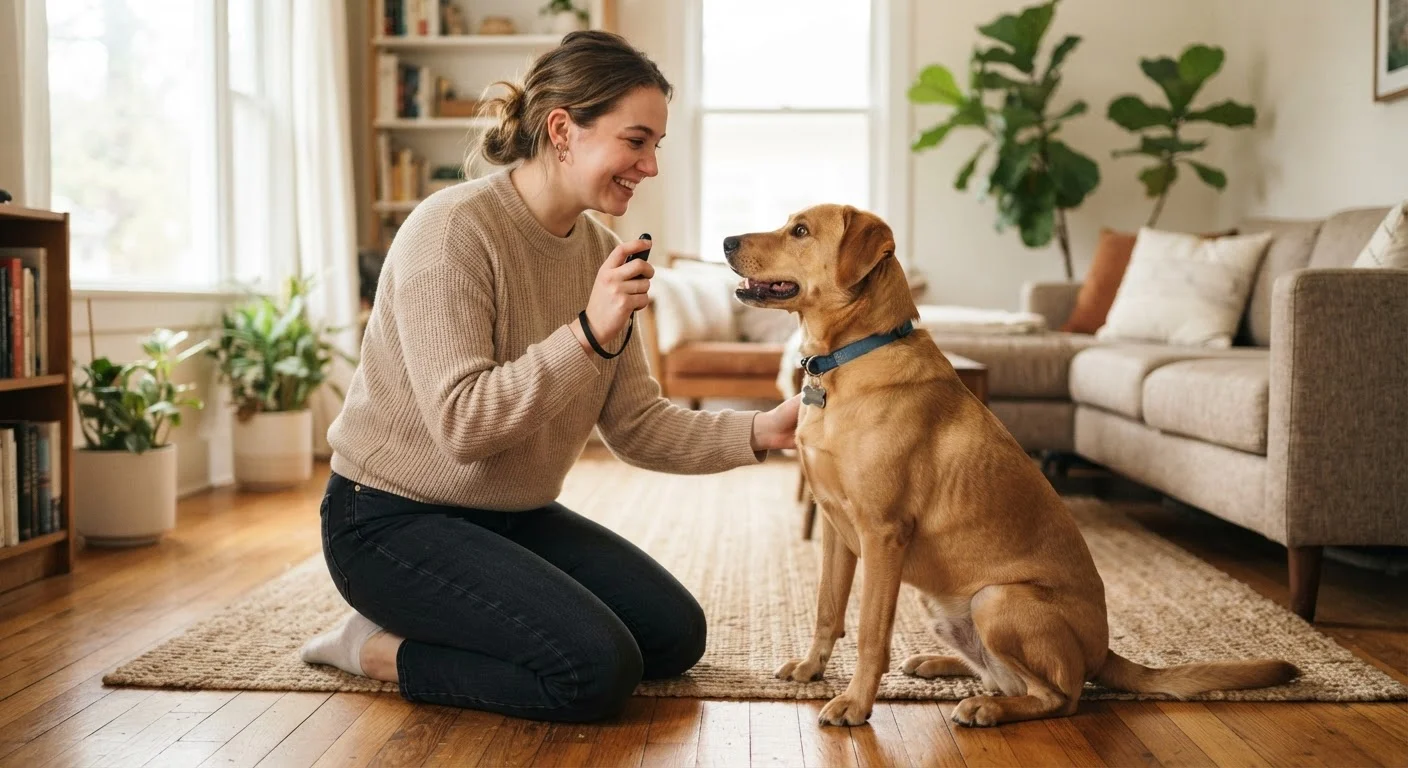
How Each Method Actually Works
Before picking a side, it helps to understand what's happening behind each technique. Both clicker training and verbal cues are rooted in the same learning science - specifically, operant conditioning, where a behavior followed by something positive is more likely to be repeated. The difference lies in what signal you use to mark that moment.
With clicker training, a small handheld device makes a sharp, consistent "click" sound the instant your pet does something right. That sound becomes what behaviorists call a conditioned reinforcer - it reliably predicts a treat or reward will follow. Because the click is unique (your pet doesn't hear it outside of training), it carries a clear, unambiguous message.
With verbal cues, you use your voice - either a marker word like "yes!" or "good," or a command like "sit" or "stay" - to communicate directly with your pet. This approach requires no tools and lets you train anywhere. The trade-off is that your voice varies in tone, pitch, and volume, which can sometimes introduce inconsistency. See our pet training signals reference for a breakdown of how different signals communicate different things to animals.
| Criterion | Clicker Training | Verbal Cues |
|---|---|---|
| Upfront cost | Small cost for clicker device | Completely free |
| Timing precision | Very high - instant, consistent click | Moderate - voice speed varies |
| Portability | Requires carrying the device | Always available |
| Consistency of signal | High - same sound every time | Variable - tone and volume shift |
| Works for noise-sensitive pets | May startle anxious animals | Easier to modulate softly |
| Works for hearing-impaired pets | No - sound-based only | No - but pairs with hand signals |
| Learning curve for owner | Slight - timing practice needed | Low - intuitive to use |
| Suitable for cats | Yes, with patience | Yes, with short sessions |
What the Research Suggests
Animal behavior science broadly supports both approaches when used correctly. Studies on dogs have found that timing of reinforcement is one of the most critical factors in effective training - meaning the faster you can mark a desired behavior, the clearer the message. This is where clickers hold a practical edge: a click is faster and more physically consistent than saying a word.
That said, research also shows that many animals respond strongly to human voices, especially when those voices carry emotional warmth. Verbal praise activates reward-processing regions in dog brains, according to neuroimaging studies published in peer-reviewed journals. So verbal cues aren't just a fallback - they're genuinely meaningful to many pets.
For cats, the picture is different. Felines are often more food-motivated than praise-motivated and respond to training in shorter, lower-pressure sessions. If you've ever wondered why your cat tunes you out, our article on why cats ignore commands digs into the behavioral reasons behind it.
~10 sec
Window for effective reinforcement timing
Animal behavior research suggests reinforcement is most effective when delivered within seconds of the target behavior, underscoring why marker timing matters.
72%
Dog owners who use verbal commands primarily
According to a survey by the American Pet Products Association, the majority of dog owners rely primarily on voice-based commands during everyday training.
3-5 min
Recommended session length for cats
Animal behavior specialists generally recommend keeping training sessions with cats very short to maintain focus and avoid frustration.
The Real-World Cost Comparison
One reason this question matters for budget-conscious pet owners: clicker training has a small upfront cost. Basic clickers are inexpensive and widely available, but they're still an item you need to buy, carry, and not lose. If you're working with multiple pets or in multiple rooms, you may find yourself wanting more than one.
Verbal cues, on the other hand, cost absolutely nothing. Your voice is already there. This makes them an ideal starting point for anyone exploring budget pet care approaches. If you later decide to layer in a clicker for precision work, that's a meaningful upgrade - not a requirement.
For a comprehensive look at keeping training costs down across the board, check out our guide on pet training on a tight budget.
Combining Both: The Practical Middle Ground
Here's something many trainers agree on: you don't have to choose. A common and effective approach is to start with a clicker to establish a clear marker signal early in training, then gradually introduce a verbal cue alongside the click - and eventually phase the clicker out once the word is reliably understood.
For example, when teaching "sit," you might click at the exact moment your dog's rear hits the floor, then immediately say "yes" and reward. Over time, the verbal marker takes over, and the clicker becomes optional. This mirrors the approach in our guide to teaching sit, stay, and come for free, which walks through essential commands using only your voice and patience.
The most important factor isn't which tool you pick - it's consistency. Whatever signal you choose to mark a correct behavior, use it the same way every time. To understand the science that makes this work, explore our piece on positive reinforcement and reward-based training.
This article is for general informational purposes only and is not a substitute for guidance from a qualified animal behavior professional. If your pet shows signs of significant anxiety, aggression, or other behavioral concerns, consult a licensed veterinarian or certified animal behaviorist.