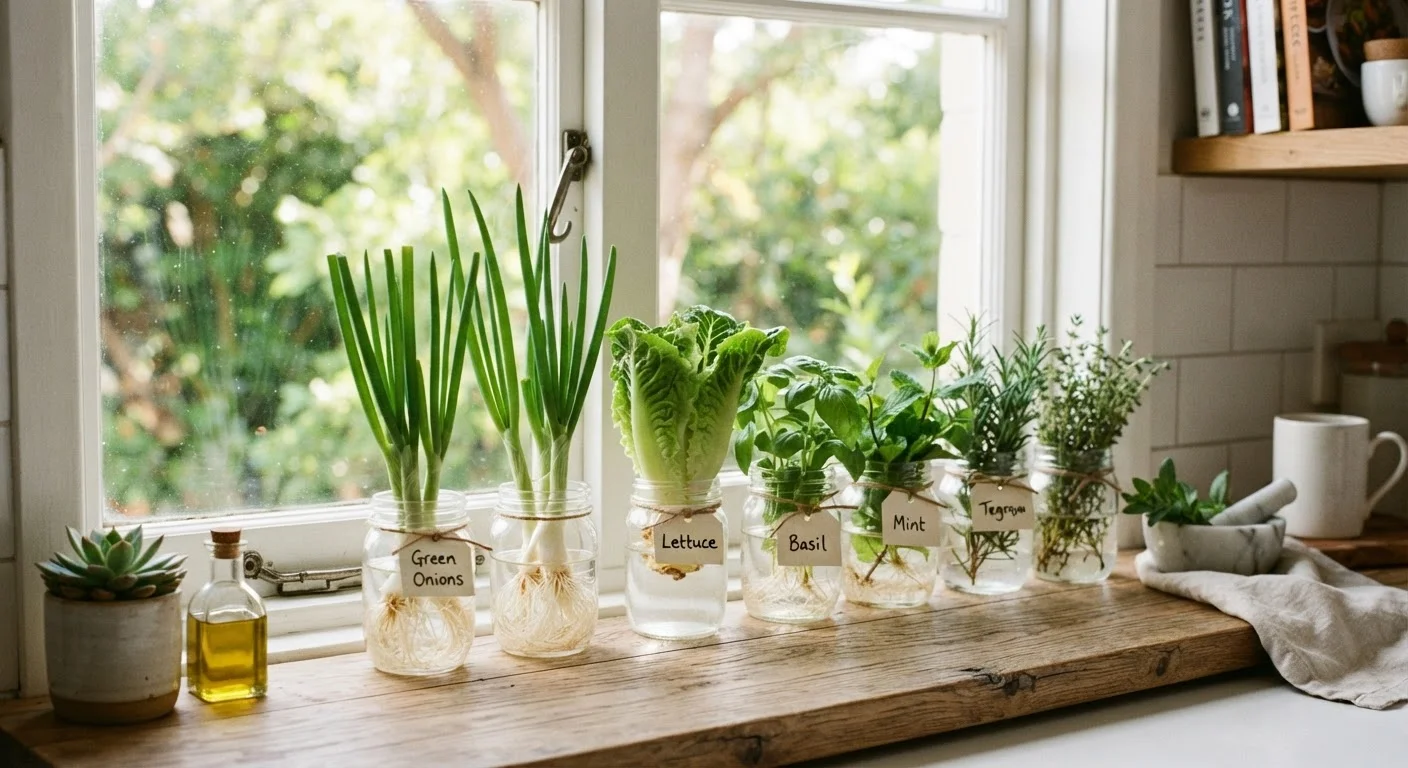
What Windowsill Regrowing Actually Delivers
Regrowing kitchen scraps in water costs almost nothing and takes up minimal space - two virtues that matter when you're watching grocery spending. The basic idea is simple: certain vegetable and herb offcuts retain enough living tissue in their base or root end to generate new growth when placed in a shallow dish or glass of water on a bright windowsill.
The honest caveat is that yields are supplemental, not transformational. You won't replace a weekly grocery run with a jar of green onion roots. What you will do is consistently trim fresh herbs or grab a handful of lettuce leaves for free, week after week. For anyone already looking at frugal ways to cut household costs, this is a practical, low-effort habit worth building.
Success rates vary considerably by plant type. The list below focuses on what genuinely works under normal home conditions - no grow lights, no fertilizers, no elaborate setup - and flags where results tend to be unreliable so you don't waste time on long-shot experiments.
Green Onions (Scallions)
Green onions are the undisputed champion of windowsill regrowing. After using the green tops in cooking, place the white root ends - roughly an inch long - in a small glass with enough water to cover the roots but not the cut end. Set it in a bright spot. Within three to five days, usable green shoots will emerge. A single bunch of store-bought scallions can be harvested multiple times before the roots exhaust themselves, typically over four to six weeks.
Trim from the top and leave at least an inch of regrowth each time so the plant can continue producing. This is one of the few scraps where results are consistently predictable regardless of season or skill level.
A single bunch of scallions can be harvested multiple times over four to six weeks.
Romaine and Butter Lettuce
Cut the leafy tops from a head of romaine or butter lettuce, leaving the bottom two inches of the base intact. Place the stub cut-side up in a shallow dish with about half an inch of water. Within a week, small new leaves will emerge from the center. These regrown leaves tend to be smaller and slightly more bitter than the original head, but they're perfectly usable in salads or sandwiches.
Replace the water daily - lettuce bases are prone to bacterial rot faster than other scraps. Expect one solid regrow cycle of two to three weeks before the base stops producing reliably. Iceberg lettuce follows a similar pattern but regrows more slowly and with less leaf mass.
Romaine bases reliably produce new leaves within a week when kept in shallow, fresh water.
Celery
Celery works similarly to lettuce: cut the stalks away leaving the bottom two to three inches of the base, then stand it in a shallow dish of water. The inner core begins generating new pale-yellow shoots within a week, which gradually green up with light exposure over two to three weeks. The new stalks won't reach full grocery-store size on a windowsill - they're better treated as a mild celery-flavored herb for soups and stocks than a full vegetable replacement.
For anyone who only uses small amounts of celery regularly, regrowing the base is a genuine money-saver since celery bunches are often partly wasted before they're used up.
Celery regrows best as a flavorful herb addition rather than a full vegetable replacement.
Fresh Basil and Mint
Store-bought living basil and mint plants - sold as potted herbs in grocery stores - can be propagated from their stem cuttings rather than discarded. Take a four-to-six-inch cutting just below a leaf node, strip the lower leaves, and place the stem in a glass of water so at least one node is submerged. Roots typically emerge within one to two weeks in a warm, bright spot.
Once roots reach about an inch long, transfer to potting mix for sustained growth. Water-only basil will eventually stagnate without nutrients from soil, so this method is a propagation step rather than a permanent growing arrangement. For a more detailed look at cuttings propagation across other plant types, see our guide to propagating from cuttings.
Basil and mint cuttings root in water within two weeks before being moved to soil.
Lemongrass
Lemongrass stalks sold in the produce section often still have a small root nub at the base. Place one or two stalks root-end down in a few inches of water in a tall glass. Change the water every two days and keep it in a warm, sunny spot - lemongrass needs more light than most windowsill regrowers. Thin white roots emerge within one to two weeks, followed by new grass-like shoots from the center of the stalk.
Once actively growing, lemongrass benefits from being moved into a pot with well-draining soil. It grows slowly indoors but can be maintained as a long-term kitchen plant used for tea and Southeast Asian cooking. It's one of the higher-effort scraps on this list but also one of the harder ingredients to find affordable and fresh in many parts of the US.
Lemongrass regrows from grocery-store stalks and eventually thrives when moved to a pot.
What Doesn't Work Well (And Why)
Several commonly recommended scraps produce disappointing results worth knowing about upfront. Avocado pits take months to sprout, require a specific setup, and produce an ornamental plant - not edible fruit - on a reasonable timeline. Onion and garlic bulbs will sprout green tops in water, but the tops are significantly more bitter than scallions and the bulbs deteriorate rapidly. Ginger can be coaxed to sprout in water, but it does far better started directly in moist soil with warmth and humidity rather than a cold windowsill jar.
Pepper and tomato seeds occasionally germinate in water but need soil and significant light to become productive plants - windowsill regrowing is not the right method for them. For readers interested in growing from seed more broadly, our plant-by-plant guide to low-maintenance edibles covers which crops offer the best return on effort.
Avocado pits, garlic tops, and ginger all underperform in water compared to their reputation.
Getting the Most From Your Scraps
Across all of the plants listed above, a few consistent habits separate reliable producers from rotting jars. Change the water every two days - stagnant water breeds bacteria that kill roots quickly. Keep jars in bright, indirect light rather than direct afternoon sun, which overheats the water and stresses young growth. Use a clean vessel, and don't overcrowd multiple plants in one container.
Keep Jars Clean to Prevent Root Rot
Algae and bacteria build up quickly in small containers exposed to light. Rinse the jar and replace the water every two days - not just topping it up. If the water turns cloudy or smells off, rinse the roots gently under cool tap water before returning them to a freshly cleaned jar. This single habit accounts for most of the difference between a thriving regrow and a failed one.
Once your windowsill garden is producing, it's worth thinking about the next step. Growing from saved seed is a complementary approach - see our guide to seed saving for how to carry productive plants into next season for free. If you want to expand beyond the windowsill, balcony gardening and budget container choices are logical next moves that don't require much space or upfront cost.