Why Design Vocabulary Matters on a Budget
When you search for decorating inspiration or read through DIY guides, you'll run into terms like focal point, scale, and visual weight - often without explanation. Understanding what these words actually mean gives you a real advantage: you can evaluate advice more critically, avoid costly mistakes, and make smarter choices with limited funds.
This glossary covers the core vocabulary budget decorators encounter most. Use it alongside our guide to affordable interior styling principles to apply these concepts in practice. If you're starting a room from zero, our step-by-step room decorating approach walks through how these terms show up in real decisions.
Accent Wall
A single wall in a room treated differently from the others - typically with a bold paint color, wallpaper, or texture. It creates visual interest and a focal point without the cost of decorating every surface.
Focal Point
The dominant element in a room that draws the eye first. It could be a fireplace, a large piece of art, or a statement furniture piece. Designing around a clear focal point gives a space a sense of intention.
Visual Weight
The sense of heaviness or lightness a piece of furniture or decor creates visually, regardless of its actual mass. Dark colors, large shapes, and dense patterns carry more visual weight than light, small, or airy ones.
Scale
The size of an object relative to other objects and to the room itself. Good scale means furniture and decor feel proportional - neither overwhelmingly large nor lost in the space.
Negative Space
The empty or open areas in a room - bare wall sections, clear tabletops, open floor. In design, negative space is intentional and helps prevent visual clutter, letting featured elements breathe.
Color Temperature
The perceived warmth or coolness of a color. Warm colors (reds, oranges, yellows) tend to make spaces feel cozier and more intimate; cool colors (blues, greens, grays) create a sense of calm and openness.
Layering
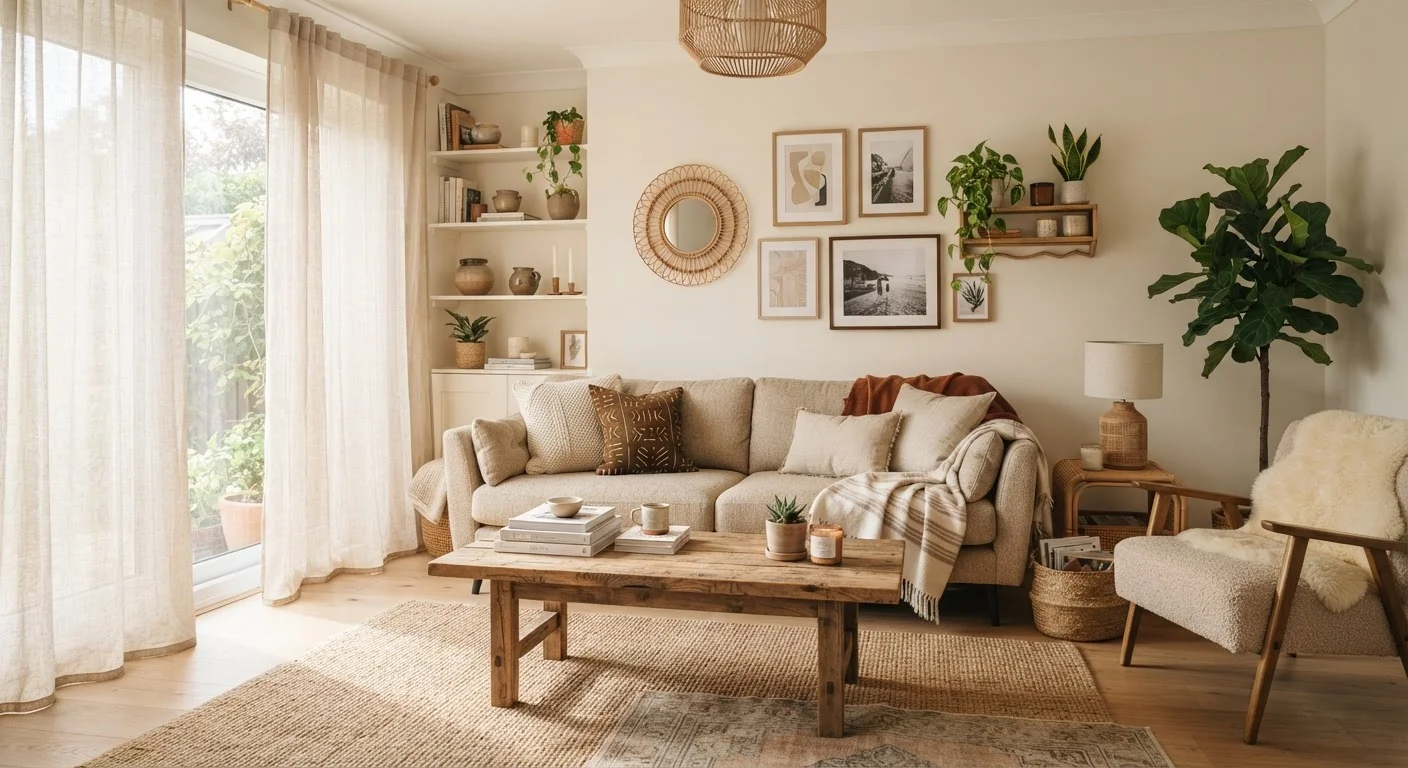
The practice of combining multiple textures, materials, and decorative elements to add depth and dimension to a space. Common layering tools include rugs placed over one another, mixed throw pillows, and varied window treatments.
Traffic Flow
The natural path people take when moving through a room. Good furniture arrangement accounts for traffic flow, leaving clear pathways of generally 36 inches or more for comfortable movement.
Vignette
A small, intentional grouping of decorative objects arranged on a surface - a shelf, side table, or mantle - to tell a visual story. Vignettes are a low-cost way to add character and personality to a room.
Cohesion
The quality of a room where all elements feel like they belong together. Cohesion doesn't require matching sets - it can be achieved through a consistent color palette, repeated shapes, or a unified style theme.
Statement Piece
A single standout item - a bold chair, oversized mirror, or distinctive light fixture - that anchors a room's personality. Budget decorators often invest more selectively in one statement piece and keep everything else simple.
Proportion
The relationship between the sizes of different elements within a room. Closely related to scale, proportion affects how balanced and harmonious a space feels - for example, pairing a large sofa with appropriately sized side tables.
How to Use These Terms When Planning Your Space
Design jargon only helps if it translates into action. Here's how some of these terms connect to practical, low-cost decisions:
- Accent walls are one of the most cost-effective ways to create a focal point. A single wall painted in a contrasting color costs a fraction of decorating the whole room.
- Visual weight guides furniture arrangement without spending anything. Redistributing heavy-looking pieces can make a room feel more balanced immediately.
- Negative space is free. Leaving surfaces clear is a deliberate design choice, not an unfinished room.
- Scale errors are among the most expensive decorating mistakes - buying a sofa that's too large or artwork that's too small for a wall. Getting scale right costs nothing but attention.
- Layering textures through affordable textiles - throw pillows, blankets, inexpensive rugs - adds depth without structural changes.
Before spending anything, use the room-by-room decorating checklist to audit what you already have in light of these concepts. For a broader overview of how to plan your decorating budget from start to finish, see our end-to-end budget decorating guide.
If managing money for home projects feels overwhelming, basic budgeting strategies can help you allocate funds more deliberately before you start shopping.
| Minimum traffic pathway width | 36 inches (General interior design guidance) |
| Typical accent wall cost vs. full room repaint | Roughly 25% of the cost (General DIY cost estimation) |
| Rule of thumb for art placement | Center artwork at eye level (~57-60 inches from floor) (Standard museum and gallery hanging practice) |
| Recommended area rug sizing | Front legs of all furniture on rug, or full furniture grouping on rug (Common interior design proportion guidance) |
| Objects per vignette (common guideline) | Odd numbers - typically 3 or 5 (Widely cited visual design principle) |