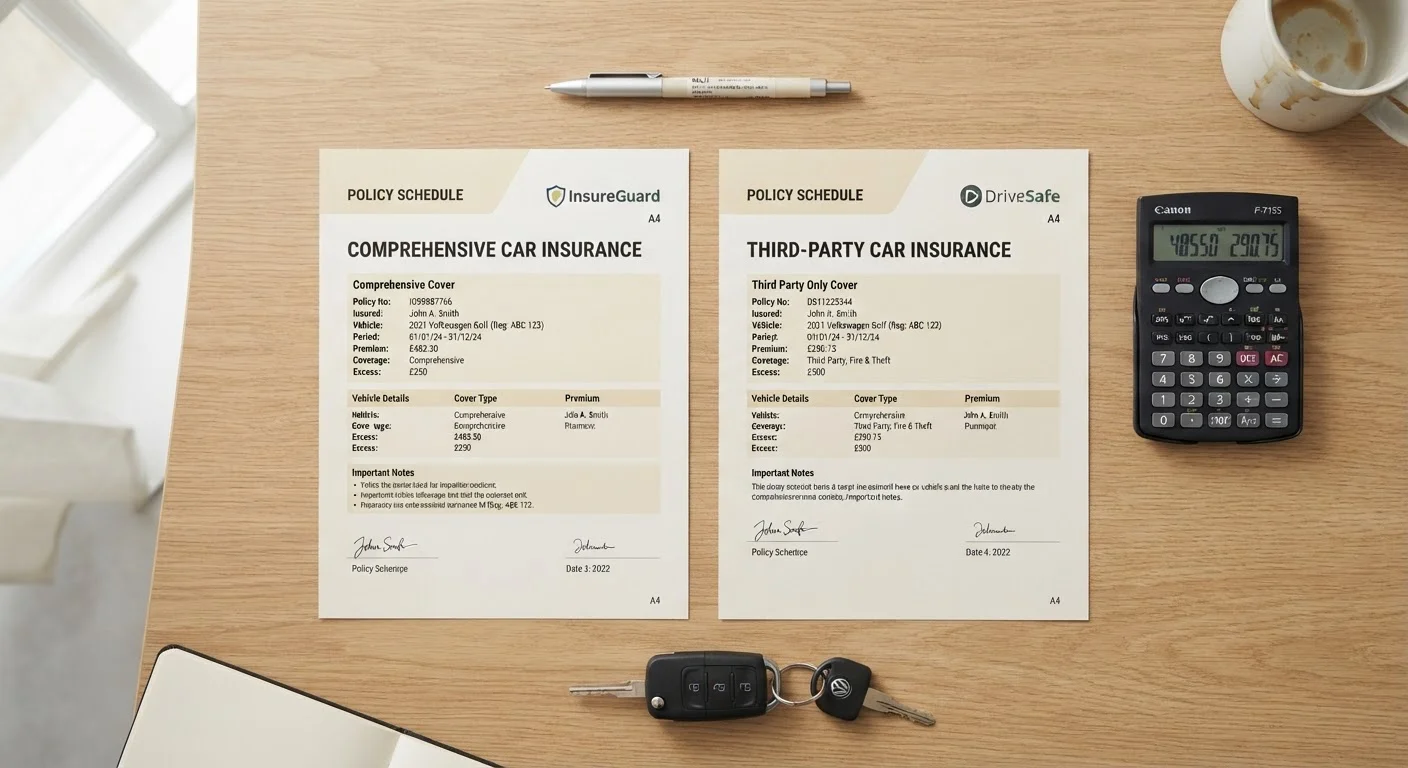
What Each Policy Actually Covers
Third-party car insurance is the legal minimum in most U.S. states. It pays for damage or injury you cause to other people - their vehicle, property, or medical costs. It does not pay for repairs to your own car, regardless of fault. If you rear-end someone and your car is badly damaged, you are entirely responsible for fixing it.
Comprehensive insurance (often sold alongside collision coverage in the U.S.) extends protection to your own vehicle. It covers damage from theft, weather events, fire, and collisions - with your insurer picking up the repair or replacement cost, minus your deductible. For a full picture of how each clause is worded, see how to read your car insurance policy before signing anything.
The Cost Equation: Premiums vs. Out-of-Pocket Risk
The assumption that third-party is always the cheaper option is not always accurate. Insurers often price third-party policies similarly to comprehensive for young or high-risk drivers, because statistical claim patterns influence pricing across all tiers. In some cases, comprehensive premiums are only marginally higher - making the additional protection difficult to pass up.
The real calculation is this: compare your annual premium difference against your car's current market value and your ability to pay for repairs without insurance. If your car is worth $2,000 and comprehensive costs $600 more per year, the math may favor third-party. If your car is worth $15,000 and the difference is $400 per year, comprehensive offers meaningful protection for a relatively small added cost.
| Comprehensive | Third-Party Only | |
|---|---|---|
| Legal minimum requirement | Exceeds minimum | Meets minimum |
| Covers damage to other parties | Yes | Yes |
| Covers your own vehicle | Yes | No |
| Covers theft of your vehicle | Yes | No |
| Typical premium level | Higher | Lower to comparable |
| Out-of-pocket risk if at fault | Limited to deductible | Full repair cost |
| Required for financed vehicles | Typically yes | Rarely accepted |
| Best suited for | Newer or higher-value cars | Older, low-value vehicles |
These costs are general illustrations only - actual premiums vary by state, driving record, vehicle type, and insurer. This content is general financial information and is not personalized financial or insurance advice. Consult a licensed insurance professional for guidance specific to your situation.
Key Factors That Should Drive Your Decision
Vehicle value: A common rule of thumb is to consider dropping comprehensive coverage when the annual premium exceeds 10% of the car's market value - but this is a general guideline, not a guarantee of the right outcome.
Loan or lease obligations: If your car is financed or leased, the lender will almost certainly require comprehensive coverage. Choosing third-party on a financed vehicle may violate your loan agreement.
Your financial cushion: Can you absorb a $5,000 repair bill without significant hardship? If not, comprehensive cover reduces that exposure. Insurance costs are just one piece of the broader ownership picture - our complete car ownership cost breakdown covers how insurance fits alongside fuel, maintenance, and registration.
Driving environment: High theft areas, harsh weather regions, or heavy daily commuting increase the likelihood that you'll need to make a claim on your own vehicle.
Common Mistakes Young Drivers Make
Choosing third-party purely on monthly premium without accounting for the total financial risk is the most frequent misstep. A single at-fault accident or theft event can cost far more than years of premium savings - especially for drivers without emergency savings to draw on.
Equally, some drivers pay for comprehensive cover on a car that has depreciated to the point where a payout would barely cover the deductible. Checking your vehicle's actual cash value annually helps keep your coverage decisions aligned with reality.
Understanding excess (your deductible) is also critical. A low premium with a high deductible may offer less real protection than it appears. Hidden costs that catch new drivers off guard include this kind of gap - worth reading before you finalize any policy.
Review Your Coverage Every Policy Year
As your car depreciates, the right coverage level can change. Set a reminder each renewal period to check your vehicle's current market value against what you're paying for comprehensive cover. If the gap has narrowed significantly, it may be time to reassess - but always weigh the full financial picture, including your deductible and emergency savings, before reducing coverage.