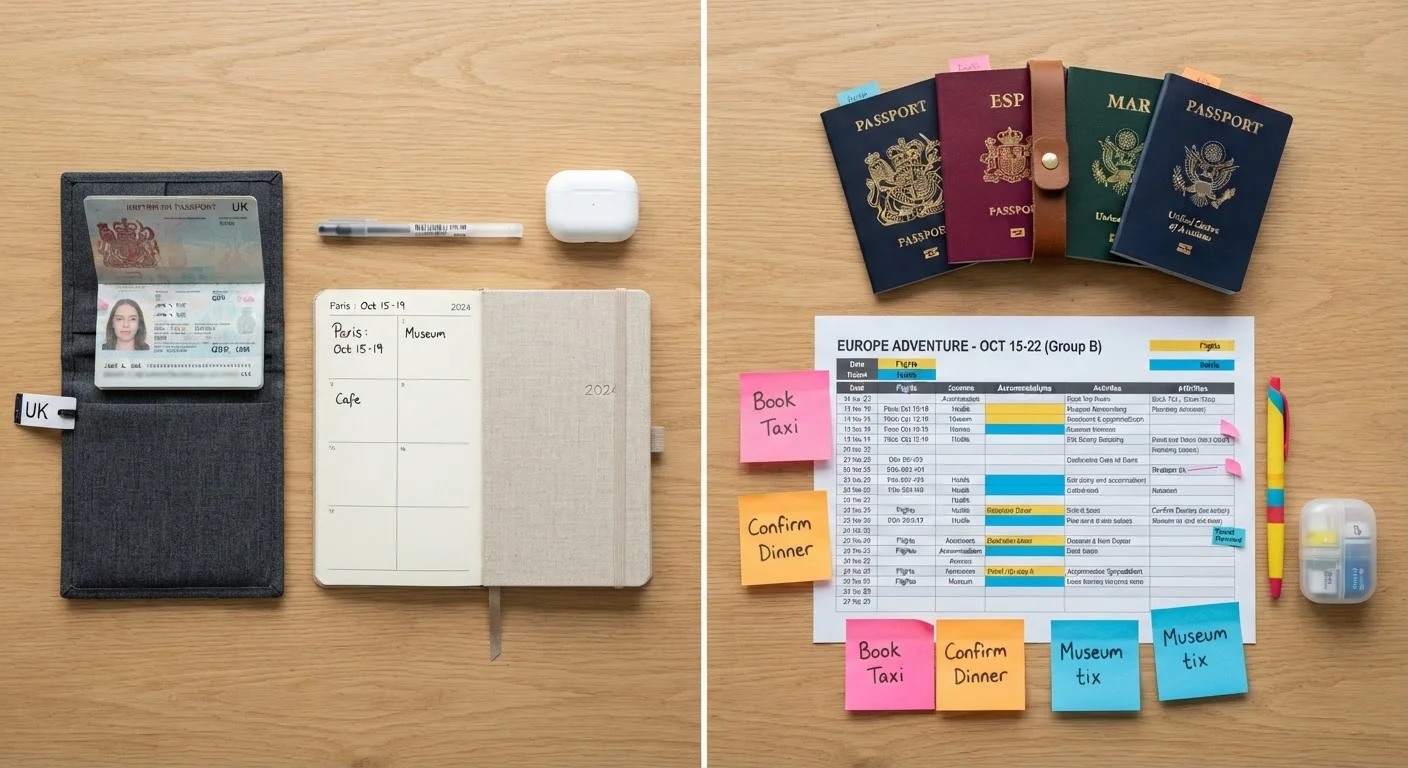
The Planning Timeline: Why Group Trips Need More Lead Time
Solo travellers can realistically plan a domestic trip in two to three weeks. A group of five or more heading to the same destination often needs three to six months - not because the logistics are inherently harder, but because aligning five sets of work schedules, budgets, and preferences takes time.
The bottleneck is rarely flights or hotels; it's consensus. Every decision that takes a solo traveller five minutes - where to stay, what dates to fly, how many nights - can require a group thread, a poll, and at least one follow-up reminder. If you're organising a group trip, build that friction into your timeline from day one.
For a practical overview of what each planning stage actually involves, see The Anatomy of a Well-Planned Trip.
Budget Dynamics: Shared Costs vs. Solo Flexibility
Group travel's most tangible financial advantage is cost-sharing. Splitting a vacation rental among four people routinely undercuts the per-person rate of two separate hotel rooms. Shared ground transport - a rental van, airport transfer, or private tour - follows the same logic: the per-head cost drops as headcount rises.
Solo travellers, however, hold a different kind of budget power: agility. Without anyone else's schedule to accommodate, a solo traveller can book the Tuesday flight that's $90 cheaper than Saturday, or shift a trip by two weeks to hit the shoulder season. That flexibility is genuinely difficult to replicate in a group setting where everyone has already requested time off.
| Planning Factor | Group Travel | Solo Travel | |
|---|---|---|---|
| Lead time needed | 3-6 months typical | 2-6 weeks typical | |
| Accommodation cost per person | Lower (shared rooms/rentals) | Higher (single occupancy) | |
| Date flexibility | Low - tied to group availability | High - pivot anytime | |
| Decision-making speed | Slow - requires consensus | Fast - one person decides | |
| Administrative burden | Distributed but complex | Concentrated but simpler | |
| Itinerary adaptability | Limited mid-trip changes | Easy real-time adjustments | |
| Transport cost per person | Lower when shared | Full cost absorbed solo |
For destination ideas that reward both approaches, browse budget travel destinations and on-the-road savings strategies.
Decision-Making and Accountability in Group Trips
One structural problem in group travel planning is diffused accountability. When no one person owns a decision, deadlines slip. A flight that was $280 per person when first discussed can be $390 by the time everyone agrees to book it. Designating a point person - not to make unilateral decisions, but to own the process - reduces that drift significantly.
A shared budgeting document (a simple spreadsheet works) established in week one helps pre-empt the most common post-trip friction: disputes over who paid for what. Collect a shared fund for predictable group expenses upfront rather than tracking individual IOUs across a two-week trip.
Solo travellers bypass this entirely, but they absorb all the administrative burden themselves. If spreadsheets and booking research aren't your strong suit, the first-time independent traveller guide offers a structured starting framework.
Itinerary Flexibility and Pace
Group itineraries trend toward over-scheduling because they're trying to satisfy multiple people simultaneously. The result is often a packed day-by-day agenda that leaves little margin for transit delays, spontaneous detours, or simply needing a slower morning. That pressure compounds on longer trips.
Solo travellers can adjust pace in real time - extend a stay, skip an attraction, or reroute entirely without negotiation. That said, solo planning carries its own pitfall: under-structuring. Without external commitments, it's easy to let each day remain vague until arrival, which creates its own stress and can lead to poor last-minute spending decisions.
Both approaches benefit from understanding common itinerary mistakes. The itinerary planning pitfalls guide covers the patterns that derail both group and solo trips.
If either format starts feeling too rigid, it may be worth considering slow travel as an alternative approach - fewer destinations, longer stays, lower per-day costs.