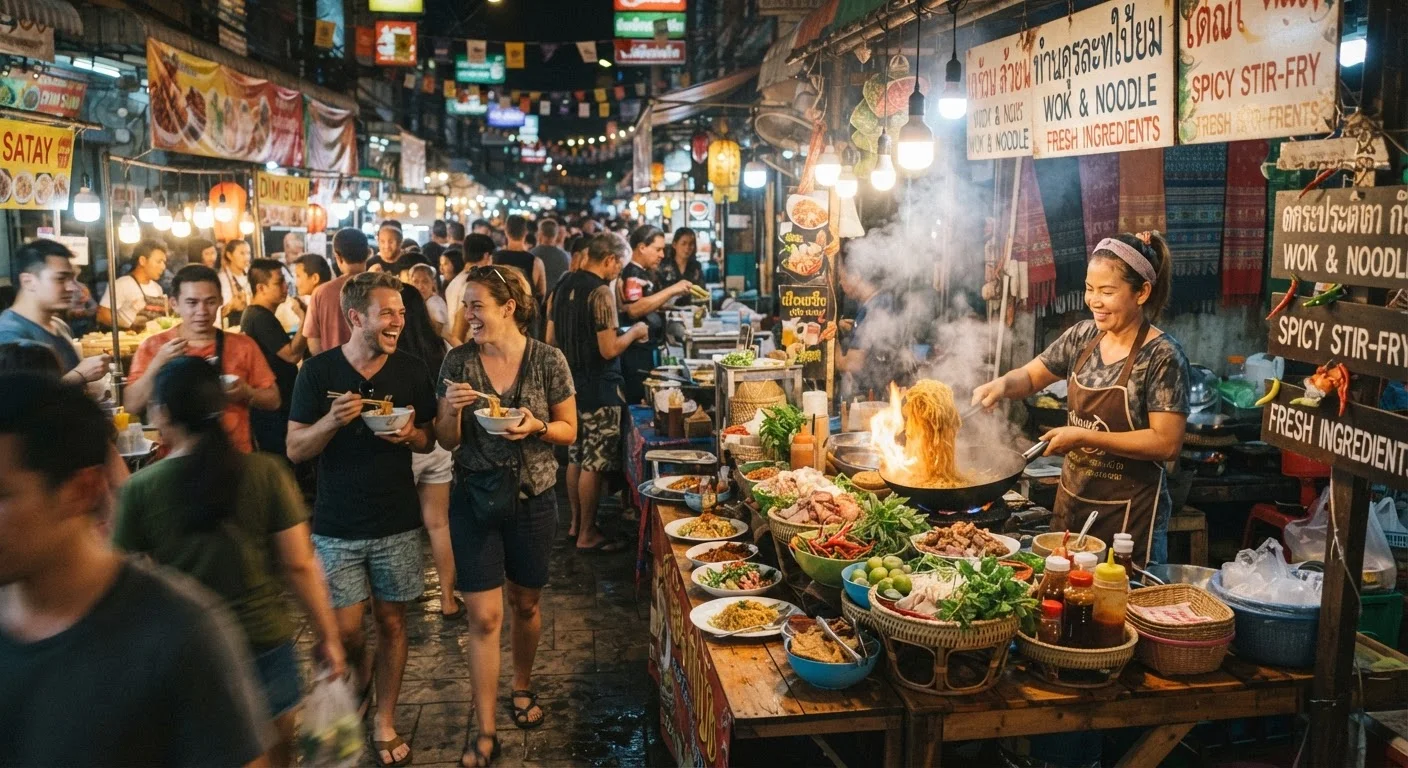
Why Street Food Gets an Undeserved Bad Reputation
For many first-time international travelers, street food triggers an almost reflexive anxiety. The open-air setup, the absence of a health department grade card on the wall, the proximity to traffic - all of it reads as risk. But that instinct is largely built on unfamiliarity rather than evidence.
Foodborne illness is a real concern when traveling, but the causal factors are more nuanced than "eat at a restaurant, stay safe; eat at a stall, get sick." Research on travel-related gastrointestinal illness consistently points to contaminated water, inadequate handwashing, and cross-contamination as the primary culprits - none of which are specific to street food environments. A poorly managed restaurant kitchen can produce the same outcomes as a careless street vendor.
Understanding what actually drives food safety - and what doesn't - allows travelers to make informed choices rather than defaulting to expensive tourist-facing restaurants that offer false reassurance. For a broader look at how perceived safety often diverges from real value, see our guide on frugal living and false economy.
Myth
Street food is more likely to make you sick than eating at a sit-down restaurant.
Fact
The setting alone does not determine food safety - preparation practices, ingredient handling, and water quality are the decisive factors regardless of venue type.
Multiple public health studies on traveler's diarrhea have found no consistent evidence that street food consumption is the primary driver of illness compared to restaurant dining. The World Health Organization's guidance on food safety identifies temperature control, cross-contamination, and water hygiene as the key risk factors - issues that can occur in any food service environment. A high-end restaurant using unsafe water in its ice or salad wash can produce the same outcome as a careless street stall. Vendor selection based on observable practices is a more evidence-aligned strategy than venue avoidance.
Myth
Street food is nutritionally poor and won't fuel you properly for a day of travel.
Fact
Many street food staples are built around whole grains, legumes, vegetables, and lean proteins - nutritional profiles that compare favorably with processed fast food alternatives.
A bowl of congee with egg, a serving of grilled fish with rice, or a lentil-stuffed flatbread can be nutritionally substantive meals. The assumption that street food is inherently junk food reflects a bias toward Western fast-food frameworks. Regional street cuisines have evolved around affordable, filling ingredients - often the same base foods discussed in general nutrition guidance. The preparation method (grilled vs. deep-fried, fresh vegetables vs. none) matters more than the stall format. For context on how budget eating intersects with nutritional quality, see Nutrition Basics.
Myth
You should stick to street food only in countries you've heard are "safe" for it.
Fact
Food safety depends on specific preparation practices, not a country-level reputation - and that reputation is often shaped by outdated information or traveler anecdote.
Country-level generalizations about street food safety are unreliable. Food safety conditions vary enormously within a single city, let alone a country. A vendor in a region with a cautious reputation may follow rigorous practices; a stall in a celebrated food destination may not. Evaluating observable preparation standards at the individual stall level - cooking temperature, ingredient handling, water sources, turnover - gives you far more actionable information than geographic reputation. Relying on reputation alone can lead travelers to overspend at tourist-facing restaurants while missing lower-risk, lower-cost local options.
Myth
Eating street food is only worthwhile in Asia - elsewhere it's not a real cost-saver.
Fact
Street food cultures exist across Latin America, the Middle East, Africa, and Southern Europe, and represent genuine savings opportunities in nearly every region.
The association of street food with Southeast Asian travel is a product of popular travel media, not culinary geography. Tacos and elotes in Mexico, shawarma in the Middle East, brik in Tunisia, arancini in Sicily - these are affordable, widely available, and culturally central. In many destinations, the price gap between a street meal and a sit-down meal for tourists is substantial enough to meaningfully affect a daily food budget over a multi-week trip. Dismissing street food outside a narrow geographic frame is a missed savings opportunity, not a safety precaution.
Myth
If a stall looks simple or makeshift, the food is probably lower quality.
Fact
Physical setup has no reliable correlation with food quality or safety; some of the most respected local food in any destination comes from the most minimal stalls.
A plastic stool, a single burner, and a handwritten sign are not indicators of quality. Many iconic regional dishes are produced by vendors who have refined a single recipe over decades. Elaborate setups with printed menus and multiple staff can just as easily reflect marketing investment aimed at tourists rather than culinary investment. Judging by physical appearance rather than observable preparation practices leads travelers toward higher-cost options without any corresponding improvement in safety or quality. The same critical thinking applies in other consumer contexts - as explored in our piece on saving and frugal tips.
Reading the Stall: Practical Safety Signals
Once you accept that street food risk is manageable rather than inherent, the next step is knowing what to actually look for. A few consistent signals are far more reliable than gut feeling or price point.
80%
Share of world population relying on street food daily
The Food and Agriculture Organization of the United Nations has estimated that a large proportion of the global urban population depends on street food as a primary food source.
~$2-5
Typical street meal cost vs. $15-30 at tourist restaurants
Cost comparisons across popular travel destinations consistently show street meals running at a fraction of sit-down tourist restaurant prices for equivalent caloric intake.
Crowd size and turnover rate are your strongest proxy for freshness. A stall with a queue indicates that food is being cooked and sold continuously - ingredients don't sit around long enough to become hazardous. A stall with no customers at 1 p.m. in a busy market is a more meaningful warning sign than one that lacks a roof.
Visible cooking temperature matters too. Food cooked to order over high heat - grilled, stir-fried, deep-fried - carries lower risk than pre-cooked items sitting at ambient temperature. If you can see the flame and the sizzle, that's actionable reassurance.
Ingredient handling is worth a few seconds of observation. Are raw and cooked items kept separate? Does the vendor use the same surface or utensils for both? These are the same standards you'd apply to any food preparation environment. For more on how food quality intersects with cost and storage, our piece on frozen vs. fresh produce offers a useful parallel on how handling affects nutritional integrity.
Water is the variable most travelers overlook. Ice, fresh salads washed in tap water, and sauces diluted with water can introduce risk independent of the cooking quality. In regions where tap water is not recommended for drinking, apply the same logic to anything that could have contacted it - this applies at restaurants as much as at street stalls.
Eating street food strategically connects directly to keeping daily food costs realistic. For field-tested approaches to food budgeting on the road, see eating well on a tight travel budget and stretching a daily food budget.
This article provides general travel and food safety information for educational purposes. It is not a substitute for guidance from a qualified health professional or official public health authority. Always verify current health advisories and entry requirements with official government and medical sources before traveling.