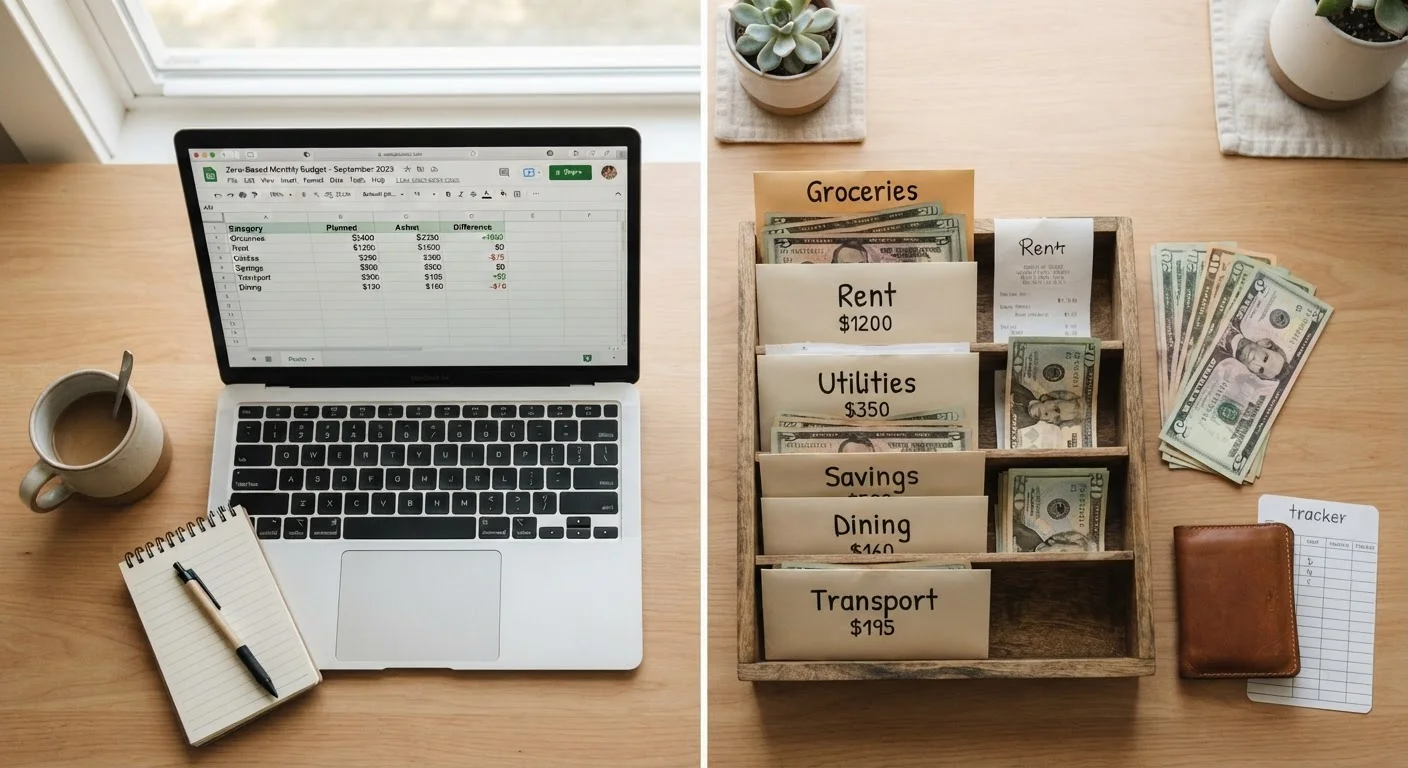
How Each Method Actually Works
Both zero-based budgeting and envelope budgeting share a core philosophy: no dollar should float around without a designated purpose. But the mechanics - and the mental habits they require - are genuinely different.
Zero-based budgeting (ZBB) starts with your total monthly income. You then assign every dollar to a category - rent, groceries, utilities, savings, debt payments, entertainment - until the math reaches zero. Income minus all allocations equals zero. Nothing is left unassigned. If your income changes next month, you rebuild the plan from scratch.
Envelope budgeting works by dividing your spending money into labeled categories - envelopes, either physical or digital. When the grocery envelope hits zero, grocery spending stops for that period. The system is as simple as it sounds, which is a genuine feature, not a bug. See our guide to envelope budgeting in a digital world for how this cash-based logic maps onto modern apps.
Neither method requires expensive tools. A notebook and a calculator are enough for either approach, though most people eventually migrate to spreadsheets or apps.
Side-by-Side Comparison
The table below compares the two methods across the dimensions that matter most to everyday users - time investment, flexibility, and the type of discipline each demands.
| Criterion | Zero-Based Budgeting | Envelope Budgeting |
|---|---|---|
| Core principle | Income minus all allocations = zero | Spend only what's in each envelope |
| Setup time | 30-60 min per month to rebuild plan | 15-30 min to fill envelopes each period |
| Best habit it builds | Intentional allocation before spending | Real-time awareness of category limits |
| Handles irregular income | Well - rebuilt fresh each month | Requires manual envelope adjustments |
| Savings integration | Savings is a named budget line | Requires a dedicated savings envelope |
| Digital-friendly | Yes - spreadsheets or apps work well | Yes - digital envelope apps available |
| Learning curve | Moderate - requires monthly planning | Low - intuitive category limits |
| Risk of abandonment | Higher if monthly rebuild feels burdensome | Higher if card spending obscures envelope totals |
For a broader look at how these methods compare to percentage-based approaches, see the tradeoffs of every major budgeting method.
Where Each Method Tends to Break Down
Understanding a method's friction points helps you choose - and troubleshoot - more honestly.
Zero-Based Budgeting Pitfalls
- Time cost: Building a new allocation plan every month takes real effort. Many people start strong in month one and gradually stop updating.
- Irregular expenses: Annual bills (car registration, holiday gifts) are easy to forget if you're only thinking one month ahead. A sinking fund - a small monthly set-aside for known future costs - helps bridge this gap.
- Math fatigue: If numbers feel stressful, rebuilding a zero-sum spreadsheet monthly can feel punishing rather than empowering.
Envelope Budgeting Pitfalls
- Category rigidity: Real life rarely respects your envelope labels. A car repair might drain three envelopes at once, requiring a manual rebalance.
- Digital friction: Most spending today happens via card or app. Tracking spending mentally against a physical envelope introduces lag - and errors.
- Savings visibility: Envelope systems focus on spending categories. Savings and debt goals can get under-represented unless you deliberately create envelopes for them.
If you're not sure which feels more natural, starting with a plain-language budget framework can help you identify your baseline habits before committing to either system.
Choosing the Method That Will Actually Stick
Budgeting research consistently points to one finding: adherence matters more than methodology. A simpler system you follow beats a sophisticated one you abandon by week three.
A Note on Budgeting Apps
Several apps are built specifically around zero-based or envelope logic. Before choosing one, consider whether the app's structure matches your chosen method - some blend both approaches in ways that can muddy either system's core discipline. Trying a simple spreadsheet or even paper first can help you understand the method before adding software complexity.
Ask yourself two honest questions before choosing:
- How do I relate to money day-to-day? If you check your bank balance frequently and enjoy planning, zero-based budgeting rewards that attention. If you prefer simple guardrails over detailed plans, envelopes give you those guardrails without requiring monthly math sessions.
- Where does my money actually disappear? If overspending is concentrated in two or three categories - restaurants, online shopping, rideshares - envelope budgeting targets those spots directly. If your issue is more diffuse, zero-based budgeting's whole-income approach may expose patterns you haven't noticed.
You can also run a hybrid: use zero-based budgeting to plan your month, then use envelope-style limits within your highest-risk spending categories. Many people find this combination provides both the big-picture control of ZBB and the in-the-moment friction of envelope limits.
For a comparison with another common framework, see how the 50/30/20 rule stacks up for young adults. And if you're thinking about your budget's relationship to an emergency fund, emergency funds and budgets work together - not separately.
This article is for general informational and educational purposes only and does not constitute personalized financial advice. Consider consulting a licensed financial professional for guidance tailored to your individual circumstances.