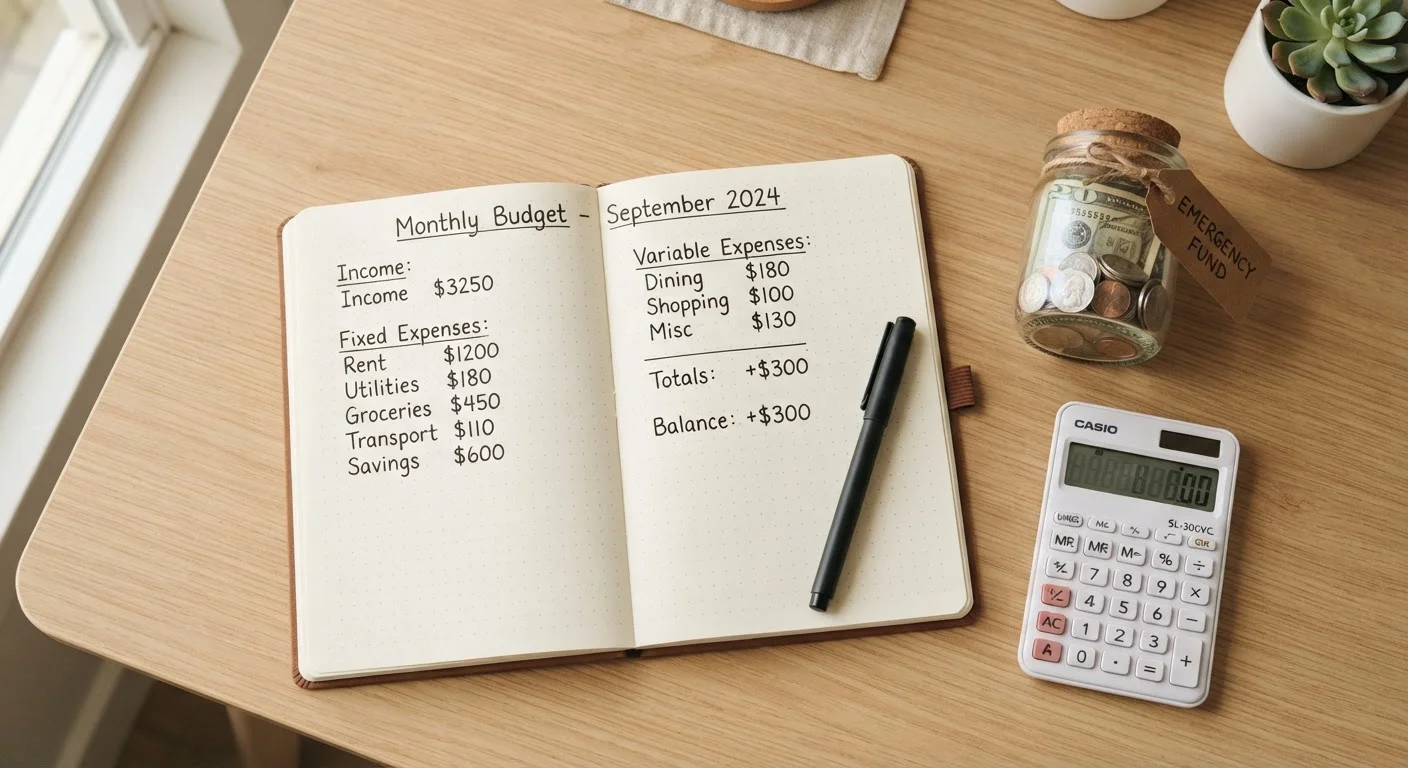
Why These Two Tools Belong Together
Most people think of a budget and an emergency fund as two different financial tasks - one is about managing what you spend, and the other is about saving for the unexpected. In practice, they only work well when they are treated as a single, integrated system.
A budget gives you a clear map of your income and expenses. An emergency fund gives you the financial shock absorber that keeps that map intact when life goes sideways. Without the budget, you likely won't find consistent room to save. Without the emergency fund, a single unexpected expense can blow up months of careful planning.
For a fuller picture of how budgeting fits into your overall financial life, see our complete budgeting guide.
Start With a Mini Emergency Fund
If saving three to six months of expenses feels overwhelming, start with a target of $500 to $1,000. This "mini" fund covers the most common financial surprises - a minor car repair, an urgent medical co-pay, or a broken appliance - without requiring months of aggressive saving. Once it's in place, you can build toward a fuller target at a comfortable pace.
How to Build Emergency Savings Into Your Budget
The most effective approach is simple: treat your emergency fund contribution like a fixed expense. Just as you budget for rent or a phone bill, assign a specific dollar amount each month to emergency savings - and pay it first, before discretionary spending.
Here is a practical framework for getting started:
- Calculate your monthly essentials. Add up rent, utilities, groceries, transportation, and any non-negotiable recurring costs. This is your baseline for how large your fund should eventually be.
- Set a realistic monthly contribution. Look at your current income versus expenses and find an amount - even $25 or $50 - that you can commit to without skipping it. Small is fine; consistent is critical.
- Assign it a budget line. Label it clearly in your budget ("Emergency Fund" or "Safety Net") so it's visible, intentional, and not confused with general savings.
- Automate the transfer. Schedule an automatic transfer to a separate savings account on payday. Removing the manual step eliminates the temptation to skip it.
If you're starting from zero with very little margin, this step-by-step approach is designed for exactly that situation.
The Difference Between Emergency Funds and Sinking Funds
One of the most common budget mistakes is using an emergency fund for expenses that were actually predictable - a car registration renewal, a holiday flight, an annual subscription. When that happens, the fund gets depleted before a real emergency arrives.
The solution is to use sinking funds for foreseeable irregular expenses. A sinking fund is a savings category where you set aside a small amount each month toward a known future cost. For example, if your car registration is $240 per year, you'd budget $20 per month into a "Car Registration" sinking fund.
Sinking funds prevent financial surprises by planning for the irregular, while your emergency fund stays untouched for the truly unforeseen. Keep the two categories separate - in your budget labels and ideally in separate savings accounts - so you always know what each pool of money is for.
What Happens When You Skip This Integration
Without an emergency fund built into your budget, most people fall into one of two patterns when an unexpected expense hits: they reach for a credit card, or they raid savings earmarked for something else.
Credit card debt triggered by emergencies carries real cost. Carrying a balance at a typical interest rate can mean paying significantly more than the original expense over time - and it creates a new fixed obligation that tightens future budgets further.
The alternative - pulling money from rent, groceries, or other savings - creates a cascade effect. One emergency reshuffles every other financial priority. An integrated approach breaks that cycle. When your emergency fund is a standing budget line, it builds quietly in the background until the moment it's needed, and your other goals stay on track.
For students managing finances for the first time, building a first budget is the natural starting point before adding an emergency savings layer.
This article is for general informational purposes only and does not constitute personalised financial advice. For guidance specific to your situation, consider speaking with a qualified financial professional.