What Actually Happens When Someone Checks Your Credit
Every time a company or individual accesses your credit report, a record of that access is created. These records are called inquiries, and they fall into one of two categories: hard inquiries or soft inquiries. Understanding which is which - and what triggers each - is one of the more practical things you can do to protect your credit score while still applying for the products you need.
To understand how inquiries fit into the bigger picture, it helps to first distinguish between your credit report and your credit score. These are related but separate things - a distinction explored in detail in this overview of credit reports versus credit scores.
<5 pts
Typical score drop from a single hard inquiry
According to FICO, a single hard inquiry lowers most consumers' scores by fewer than five points, with the effect diminishing after 12 months.
2 years
How long hard inquiries stay on your credit report
Hard inquiries are visible on your credit report for two years under FCRA rules, though scoring models generally stop counting them after 12 months.
14-45 days
Rate-shopping window recognized by scoring models
FICO and VantageScore models deduplicate multiple loan inquiries of the same type within this window, treating them as a single inquiry.
Hard Inquiries: When Applications Put Your Score on the Line
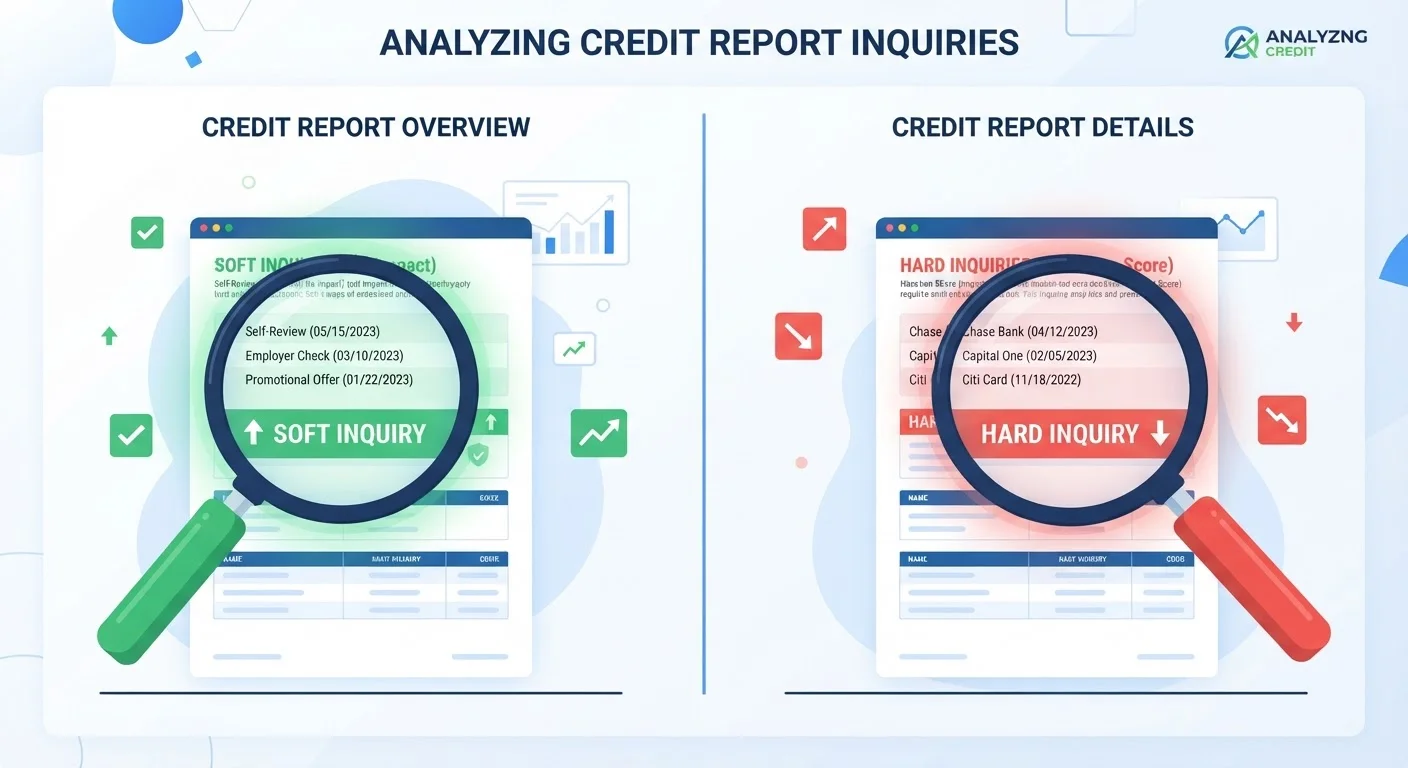
A hard inquiry - sometimes called a hard pull - happens when a lender or creditor reviews your full credit report to make a lending decision. You must typically give explicit permission for this to occur, usually when you submit an application.
Common triggers for hard inquiries:
- Applying for a credit card
- Applying for a mortgage, auto loan, or personal loan
- Applying for a student loan (private lenders)
- Some apartment rental applications
- Certain utility or mobile phone account setups
Hard inquiries do lower your score, but usually only modestly - often by fewer than five points per inquiry for most consumers. The concern arises when multiple hard inquiries accumulate in a short period outside of recognized rate-shopping windows, which can signal to lenders that a borrower is urgently seeking credit. This is one of the habits that quietly damage scores over time without borrowers realizing it.
Soft Inquiries: Credit Checks That Leave Your Score Untouched
A soft inquiry - or soft pull - occurs when your credit report is accessed for a purpose that is not a direct lending decision triggered by your application. These have no effect on your credit score whatsoever.
Common triggers for soft inquiries:
- Checking your own credit report or score
- Pre-approval or pre-qualification screenings by credit card issuers
- Background checks by employers
- Existing creditors reviewing your account for limit increases or monitoring
- Insurance company screenings (in states where permitted)
One widely held misconception is that checking your own credit score will hurt it. This is false - and it is the kind of myth that keeps people from monitoring their credit health proactively. For a fuller look at this and similar misunderstandings, see common myths about credit scores that could be holding you back.
Rate Shopping: The Exception That Protects Smart Borrowers
One of the most consumer-friendly features built into major credit scoring models is how they handle rate shopping. When you are comparing interest rates for a mortgage, auto loan, or student loan, applying to multiple lenders within a defined window - typically 14 to 45 days, depending on the scoring model - causes those multiple hard inquiries to be consolidated and counted as just one.
This matters practically. If you apply to four mortgage lenders over two weeks to find the lowest rate, your score is not penalized four separate times. The models recognize this behavior as financially responsible comparison shopping rather than desperate credit-seeking.
“Consumers should not be penalized for shopping around for the best rate. Rate shopping is a financially savvy behavior, and scoring models are designed to reflect that reality.”
— Consumer Financial Protection Bureau, U.S. federal agency overseeing consumer financial products and credit markets
This protection applies specifically to installment loan types like mortgages and auto loans. It does not apply to credit card applications, where each application is counted separately. If you are starting out and weighing your first credit options, understanding the trade-offs between secured cards, credit-builder loans, and authorized user status can help you avoid unnecessary inquiries from the start.
Practical Steps to Minimize Unnecessary Hard Inquiries
Managing inquiries does not mean avoiding all applications - it means being deliberate about when and how you apply. A few practical habits help:
- Use pre-qualification tools first. Many card issuers and lenders offer pre-qualification checks using only soft inquiries. Use these to gauge your approval odds before committing to a formal application.
- Cluster loan shopping. When comparing rates for a mortgage or auto loan, complete all your applications within the same two-week window to take advantage of rate-shopping protections.
- Limit simultaneous credit card applications. Unlike loan rate shopping, applying for multiple cards in a short period results in multiple separate hard inquiries. Space these out where possible.
- Monitor your report regularly. Reviewing your report for unauthorized inquiries is a good practice - disputing any you did not authorize is your right under federal law.
Inquiries are only one factor in your score. For most people, focus on payment history and credit utilization - the factor many people overlook - will move the needle far more than worrying about a single hard inquiry.
This article is for general informational and educational purposes only and does not constitute personalized financial or credit advice. For guidance specific to your financial situation, consult a licensed financial professional.