Why Utilisation Gets Overlooked
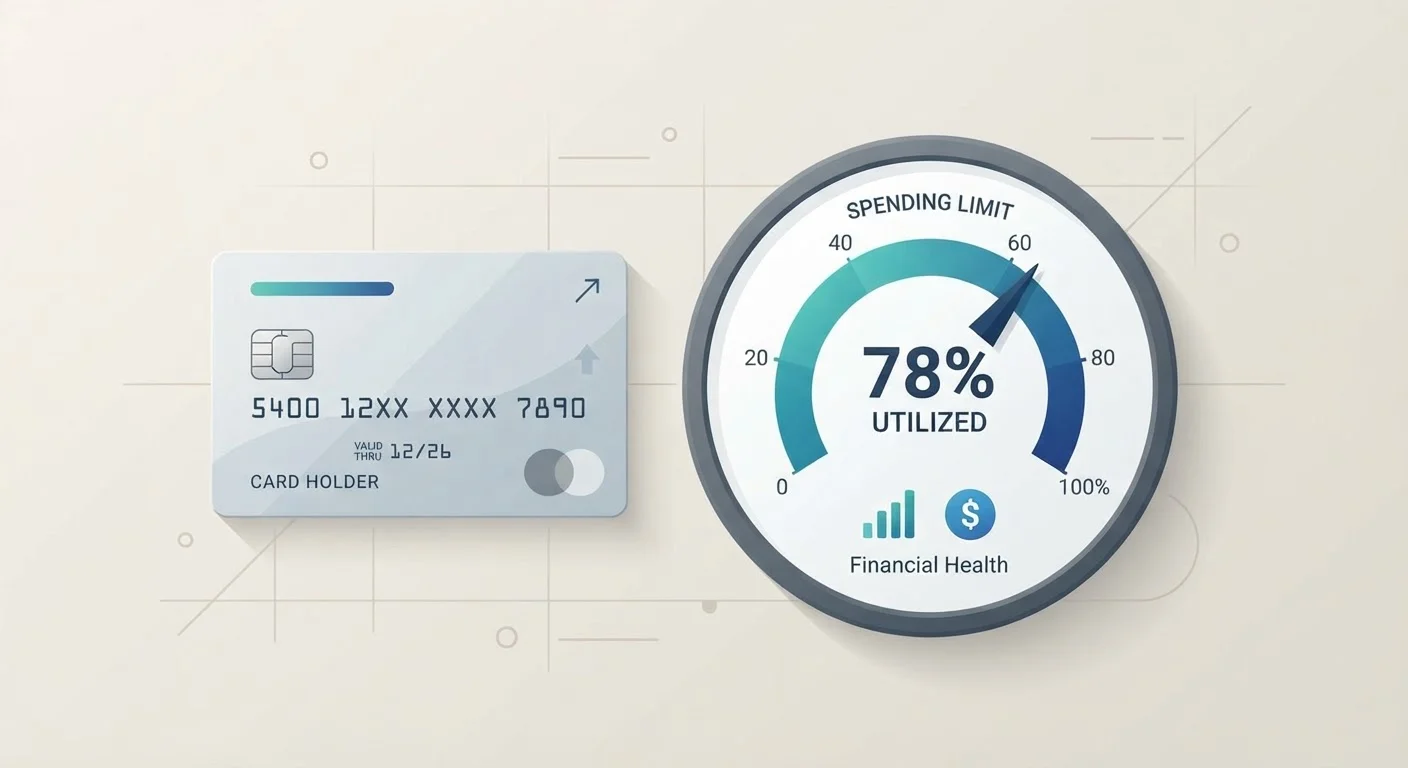
Most people know that paying bills on time matters for their credit score. Far fewer pay close attention to how much of their available credit they are actually using. This is credit utilisation, and in standard scoring models like FICO, it accounts for roughly 30% of your score - making it the second most influential factor after payment history.
The reason it slips under the radar is simple: it feels invisible. You are not missing a payment or applying for new credit. You are just carrying a balance, which most people assume is normal and harmless. But to a scoring model, a high utilisation ratio signals financial stress, even if you are managing payments comfortably. Understanding this mechanism is one of the most actionable insights in personal finance. See our guide to behaviours that quietly damage scores for related patterns worth watching.
How Utilisation Is Calculated
The formula is straightforward: divide your current balance by your credit limit, then multiply by 100 to get a percentage.
- Per-card utilisation: A $2,000 balance on a card with a $4,000 limit = 50% utilisation on that card.
- Overall utilisation: If you have three cards with a combined $12,000 limit and $3,000 in total balances, your aggregate rate is 25%.
Scoring models assess both figures. A single maxed-out card can drag your score down even if your overall utilisation looks fine - a detail many people miss entirely.
There is also a timing nuance worth knowing: your issuer typically reports your balance to the credit bureaus on your statement closing date, not your payment due date. If you charge $800 to a card and pay it off before the due date, the bureau may still see an $800 balance if the statement closed beforehand. Paying before or shortly after your statement closes - rather than just before the due date - is one practical way to control what gets reported.
~30%
Share of FICO score tied to utilisation
According to FICO's published score factor breakdown, amounts owed - primarily utilisation - is the second-largest scoring category after payment history.
<10%
Utilisation rate common among top scorers
Analyses of high-scoring consumers consistently show aggregate utilisation rates well below the commonly cited 30% threshold.
1-2
Billing cycles for score to reflect paydown
Because utilisation is recalculated each reporting cycle, paying down a balance can improve your score faster than most other credit factors.
Practical Ways to Lower Your Utilisation
There are two broad levers: reduce balances or increase available credit. Neither requires perfection - small improvements can move your score meaningfully.
Pay Down Balances Strategically
If you carry balances across multiple cards, target any card that is individually over 30% first, since per-card utilisation matters alongside the overall figure. Even a partial paydown - say, moving a card from 80% to 45% - can produce a noticeable improvement. Building a simple monthly budget can help free up extra cash to make those paydowns possible.
Request a Credit Limit Increase
If your balance stays the same but your limit rises, your utilisation ratio automatically drops. A card with a $1,500 balance on a $3,000 limit is at 50%. Raise the limit to $5,000 and that same balance is at 30%. Ask your issuer whether this triggers a hard or soft inquiry before proceeding - see our explainer on hard vs. soft inquiries for context.
Avoid Closing Cards You Do Not Use
A card you rarely use still contributes its limit to your total available credit. Closing it shrinks that total and can raise your overall utilisation overnight. Unless a card carries a costly annual fee, keeping it open and occasionally using it for a small purchase is usually the wiser financial move.
Time Your Payments for Maximum Impact
Find out when your credit card issuer reports your balance to the bureaus - this is usually your statement closing date, not your payment due date. Paying down your balance a few days before that date means a lower figure gets reported, which can meaningfully reduce your utilisation ratio for that cycle. Your issuer's customer service line or online portal can usually confirm the reporting date.
What Utilisation Cannot Tell You
Utilisation is a snapshot, not a complete picture. It reflects your balances relative to your limits at a single point in time - it does not account for your income, your savings, or your overall debt load. A person with $800 in balances on a $1,000 limit might actually be in better financial shape than a person with $40,000 in balances on $200,000 in limits, even though the latter has lower utilisation.
This is one of several reasons why credit scores are general-purpose risk tools, not comprehensive assessments of financial health. Utilisation management is a genuinely useful skill, but it is one piece of a larger picture. For a grounded view of the full set of habits that support long-term credit health, see our article on managing credit and debt well. You may also find it helpful to review common myths about credit scores that lead people to make decisions that work against them.
This article is for general informational purposes only and does not constitute personalised financial or credit advice. Consult a qualified financial professional for guidance specific to your situation.