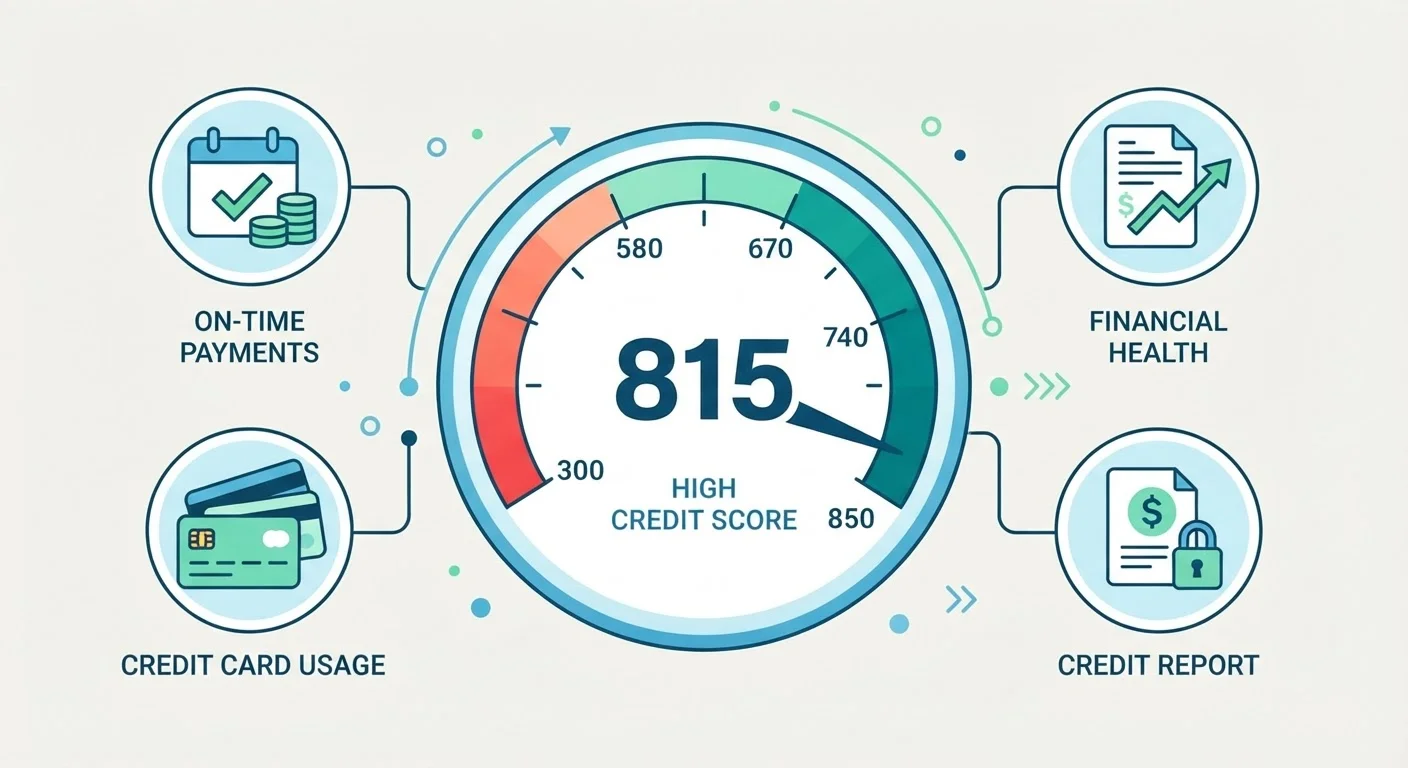
The Five Factors Behind the Number
Your credit score is not a mystery - it is a weighted formula built from five distinct categories of credit behavior. Understanding what each one measures gives you a clear map for improving your score.
- Payment history (35%): This is the largest single factor. It tracks whether you pay your bills on time across all credit accounts - credit cards, auto loans, mortgages, and student loans. Even one missed payment can cause a noticeable drop, particularly if your score is already strong.
- Amounts owed / Credit utilization (30%): This measures how much of your available revolving credit you are currently using. If you have a $5,000 limit and carry a $2,500 balance, your utilization is 50%. Lower utilization signals better credit management. Credit utilization is the factor most people underestimate.
- Length of credit history (15%): Longer histories give scoring models more data to assess. This includes the age of your oldest account, your newest account, and the average age of all accounts.
- Credit mix (10%): Lenders like to see that you can manage different types of credit - revolving accounts like credit cards and installment accounts like car loans - responsibly.
- New credit / Hard inquiries (10%): Each time you apply for new credit, a hard inquiry is recorded and can temporarily lower your score. Understanding the difference between hard and soft inquiries helps you apply strategically. See our explainer on hard vs. soft inquiries for more detail.
35%
Weight of payment history in FICO score
According to FICO's published scoring criteria, payment history is the single largest factor in calculating your score.
300-850
Standard FICO score range
FICO scores fall on a scale from 300 to 850, with higher numbers indicating lower credit risk to lenders.
~200M
Americans with a FICO score
FICO reports that its scores are used in the vast majority of U.S. lending decisions, covering the bulk of the credit-active adult population.
How Lenders Actually Use Your Score
When you apply for a loan, credit card, or even an apartment lease, the lender or landlord pulls your credit score as a fast, standardized risk signal. A higher score typically translates to easier approval, lower interest rates, and better terms - while a lower score can mean higher rates or outright denial.
It is important to understand that lenders do not rely on the score alone. They also review your full credit report, your income, your existing debt obligations, and sometimes your employment history. The score opens the door; the full picture determines what happens once you walk through it.
Different lenders also set their own score thresholds. A mortgage lender may require a minimum score of 620 for a conventional loan, while an auto lender might approve borrowers with scores in the 580-620 range at higher interest rates. There is no universal cutoff - each institution defines its own risk tolerance.
Building and Protecting Your Score Over Time
The most reliable path to a strong credit score is also the least exciting: consistent, on-time payments over an extended period. No shortcut replaces this foundation. That said, a few targeted habits make a meaningful difference.
Keep utilization low. Aim to use less than 30% of your available revolving credit at any given time - lower is generally better. If your balances are creeping up, paying them down before your statement closing date can reduce the utilization figure that gets reported.
Don't close old accounts unnecessarily. Closing a long-standing account reduces your available credit and can shorten your average account age - both of which may lower your score.
Be selective about new applications. Each hard inquiry has a small, temporary effect, but multiple applications in a short window can add up. Rate-shopping for a mortgage or auto loan is treated more leniently - most scoring models group multiple inquiries for the same loan type within a short period as a single inquiry.
Some behaviors harm scores in ways that aren't immediately obvious. The habits that quietly damage credit scores article explores the less visible patterns worth watching. And if you want to separate what's true from what's widely believed, check out common credit score myths that may be costing you.
This article is for general informational and educational purposes only and does not constitute personalized financial advice. Consult a licensed financial professional for guidance specific to your situation.