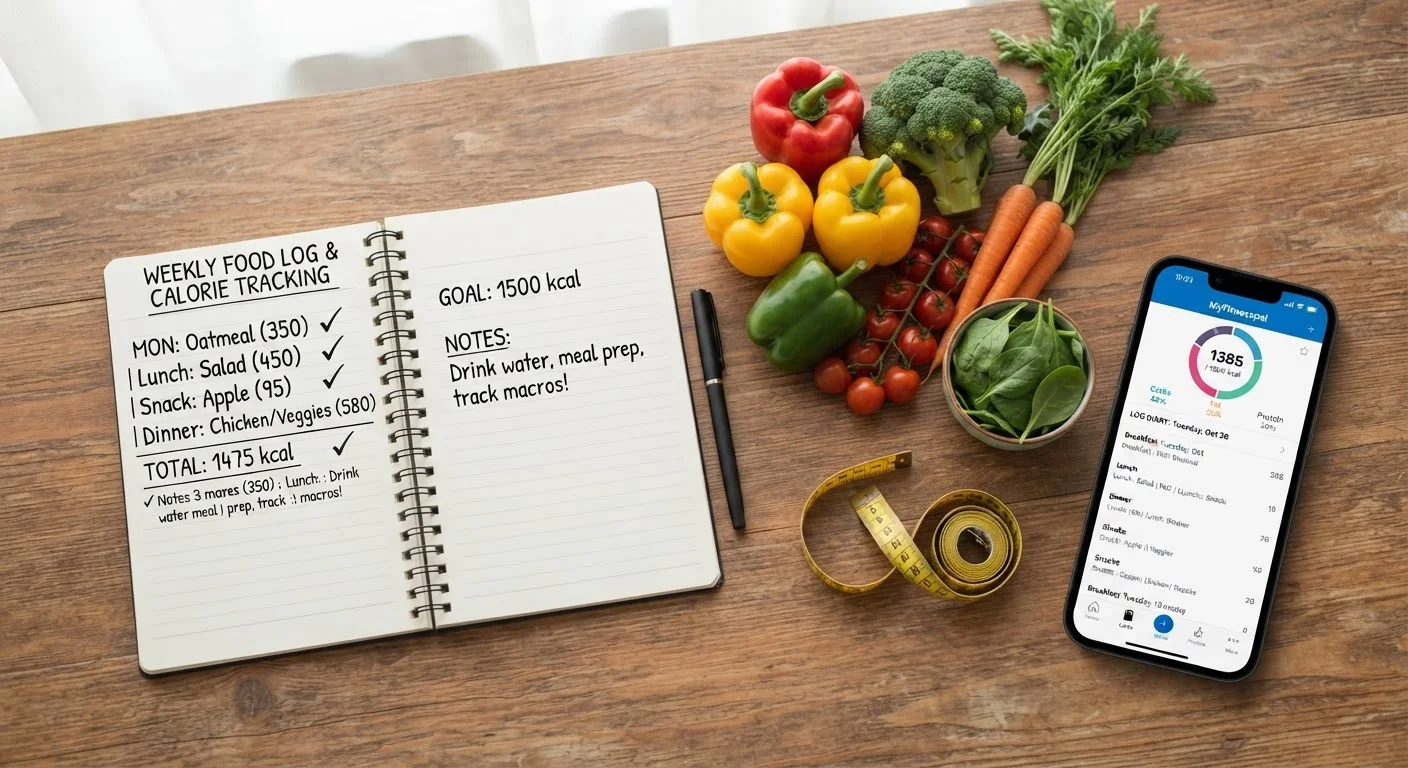
What Calorie Counting Actually Measures
A calorie is a unit of energy - specifically, the amount of heat needed to raise one gram of water by one degree Celsius. In nutrition, we use kilocalories (kcal), though they are commonly called calories on food labels. Every macronutrient delivers a different amount: carbohydrates and protein provide roughly 4 kcal per gram, while fat provides about 9 kcal per gram.
Calorie counting works by estimating how much energy you consume through food and comparing it to how much your body uses. When intake consistently exceeds expenditure over time, body weight tends to rise. When it falls short, weight tends to decrease. This energy balance concept is grounded in established physiology, though real-world factors make it more complex than a simple equation.
Understanding this baseline is genuinely useful. Many people significantly underestimate how much they eat - research has repeatedly shown this to be a common pattern. Tracking for even a short period can reveal portion distortions you had not noticed, and that awareness itself can be valuable. For more on reading the specific numbers behind what you eat, see nutrition label literacy.
The Real Strengths of Tracking Calories
Used thoughtfully, calorie awareness offers several concrete benefits for people building a foundational understanding of their diet.
Builds awareness of portion sizes
Many people have an inaccurate sense of how much they are eating. Tracking, even briefly, can calibrate your perception of portion sizes against realistic benchmarks.
Makes eating patterns visible
Logging meals over several days can reveal skipped breakfasts, high-calorie beverages, or evening eating habits that are easy to overlook without a record.
Provides a structured starting point
For people who feel overwhelmed by nutrition information, a clear, quantifiable metric can make the topic feel more manageable and actionable.
Supports goal-oriented accountability
When working toward a health goal under professional guidance, tracking offers a measurable reference point that supports conversations with a dietitian or doctor.
Up to 20%
Allowed variance on US food label calorie counts
The US Food and Drug Administration permits food manufacturers a margin of up to 20% on stated calorie figures, meaning a food labeled at 200 kcal may legally contain as few as 160 or as many as 240.
~50%
Adults who underestimate daily calorie intake
Multiple dietary recall studies have found that roughly half of adults consistently underreport or underestimate their daily calorie consumption, often by several hundred kilocalories.
Tracking also makes it easier to notice patterns - such as consistently eating very little during the day and a large amount in the evening - that may be worth discussing with a healthcare provider. It can act as a reality check rather than a rulebook.
Where Calorie Counting Falls Short
Despite its usefulness as a tool, calorie counting has meaningful limitations that are often overlooked in popular diet culture.
Ignores nutrient quality entirely
A calorie total says nothing about whether your food contains fiber, vitamins, or minerals. Two diets with identical calorie counts can differ vastly in their nutritional value.
Can disconnect you from hunger signals
Focusing on a number can override your body's natural hunger and fullness cues, making it harder over time to eat intuitively and in response to genuine need.
Calorie estimates carry significant margin of error
Database values, label figures, and personal absorption rates all vary. The FDA allows up to a 20% variance on food labels, meaning the precision implied by tracking may be illusory.
May increase food-related stress and anxiety
Rigid calorie tracking has been associated in research with heightened anxiety around eating, particularly among young adults prone to perfectionist thinking.
Does not account for how food is processed by the body
Factors like cooking method, fiber content, and individual gut microbiome differences affect how many calories your body actually absorbs from any given food.
It is also worth noting that calorie counts on labels and in databases carry an inherent margin of error. The FDA permits a variance of up to 20% on food label calorie figures, and cooking methods, food ripeness, and individual gut microbiome differences all affect how many calories your body actually absorbs. The number on a label is an approximation, not a precise measurement.
For a broader look at what a nutritious eating pattern involves beyond numbers, building a balanced plate offers a practical, flexible framework.
Calorie Counting and Mental Wellbeing
One dimension that rarely gets enough attention is the psychological effect of calorie tracking. For some people, the structure it provides is reassuring. For others, it can increase anxiety around food, fuel perfectionist thinking, or create an unhealthy preoccupation with numbers over hunger cues.
A Note on Disordered Eating Risk
If you have a personal or family history of disordered eating - including restrictive eating, binge eating, or obsessive food-related thoughts - calorie tracking is generally not recommended without professional support. This article presents general educational information. Please speak with a registered dietitian or mental health professional before starting any structured dietary tracking practice.
Research published in peer-reviewed nutrition journals has found associations between rigid dietary tracking behaviors and elevated stress, particularly in young adults. This does not mean tracking is harmful for everyone, but it does mean self-awareness matters. If logging meals feels distressing rather than informative, it is worth stepping back and speaking with a registered dietitian or mental health professional.
A useful parallel exists in personal finance: tracking your spending can build real awareness, but fixating on every transaction can become counterproductive. The same principle applies to food. Tracking without obsessing is a concept that translates directly to nutrition as well.
A More Complete Picture of Eating Well
Calories are one input in a much larger nutritional picture. Food also delivers fiber, vitamins, minerals, phytonutrients, and water - none of which appear in a calorie count. Two meals with identical calorie totals can differ dramatically in how they affect satiety, blood sugar stability, and long-term health.
For example, 500 calories from a mix of legumes, vegetables, and whole grains will digest differently and support different health outcomes than 500 calories from a heavily processed snack food - even though the number is identical. Research on sugar and diet quality illustrates how nutrient composition, not just quantity, shapes health outcomes.
Similarly, meal timing and how you eat - slowly, mindfully, in response to genuine hunger - influences how satisfied you feel and how your body processes food. Skipping meals is a common example of a calorie-reduction strategy that often backfires for reasons unrelated to the calorie math itself.
This article is for general informational and educational purposes only and does not constitute medical or nutritional advice. Please consult a registered dietitian or qualified healthcare professional for guidance tailored to your individual health needs.