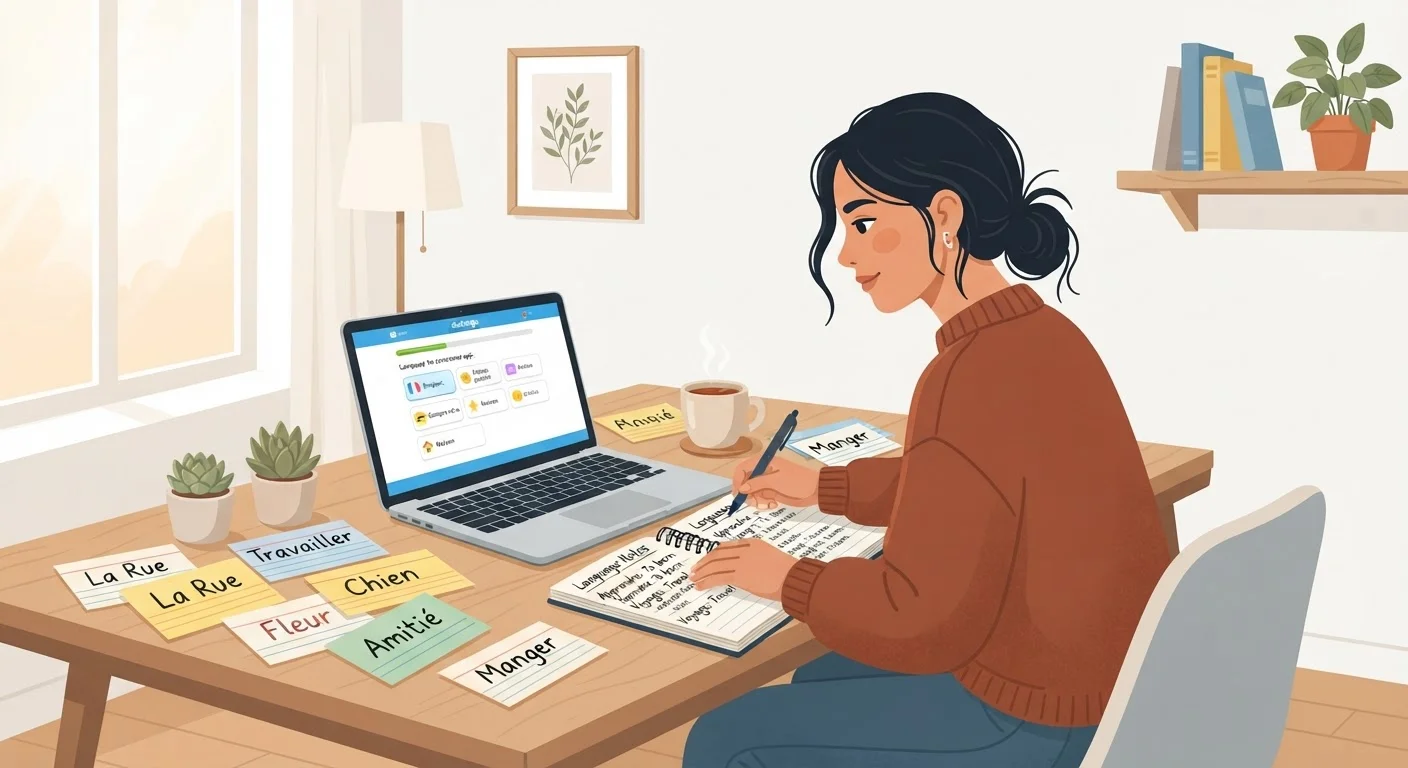
Why Most Free Language Apps Alone Are Not Enough
Free language learning apps have exploded in availability, but download numbers do not equal fluency rates. The gap between what these tools promise and what research shows they can deliver on their own is significant. Most gamified apps are engineered to keep users engaged daily - which is genuinely useful for habit formation - but they tend to emphasize vocabulary recognition over the speaking, listening, and writing skills that define real-world competence.
Understanding this distinction matters before you invest weeks in any single platform. The good news: when free tools are chosen deliberately and combined strategically, they can cover most of what a paid course offers. The key is knowing what each type of tool does well and where its limits are.
For a broader view of what free digital learning can and cannot realistically achieve, see our honest breakdown of free learning trade-offs.
Free Tools Have Real Limits
No single free app or website will take you to fluency on its own. Research consistently shows that language acquisition requires varied input, meaningful output, and human interaction - things a single platform rarely provides in full. Think of free tools as building blocks in a broader system you design yourself, not a complete solution on their own.
What the Research Says About Effective Language Learning
Decades of applied linguistics research point to a handful of principles that hold across learner backgrounds and target languages. Comprehensible input - encountering language in context you can mostly understand - is among the most studied mechanisms. Equally well-supported is the role of spaced repetition in vocabulary retention and the importance of productive output (speaking and writing) in consolidating passive knowledge into active use.
Grammar study has a place, but research suggests it works best when it supports real communication rather than replacing it. Learners who focus exclusively on grammar rules often struggle to use the language spontaneously. Free resources that integrate grammar in context - through stories, dialogues, or authentic media - tend to outperform dry drill-based approaches.
“The most successful language learners are not necessarily the most talented - they are the most consistent. Exposure over time, not intensity in a single sitting, is what drives acquisition.”
— Paul Nation, Professor Emeritus of Applied Linguistics, Victoria University of Wellington
Best Practices for Building a Free Language Learning System
The following practices are grounded in language acquisition research and work regardless of which specific free tools you choose. Apply them to whatever combination of apps, podcasts, and platforms fits your target language.
Build a daily minimum habit, even if it is just 15 minutes.
Language acquisition research, including work associated with Stephen Krashen's input hypothesis, emphasizes that consistency over time matters more than session length. Short daily contact keeps vocabulary active and builds neural pathways incrementally. Sporadic long sessions allow more forgetting between exposures.
Use a spaced repetition system (SRS) for vocabulary instead of simple word lists.
Spaced repetition schedules reviews at increasing intervals just before you would naturally forget a word, making memorization far more efficient. This method is well-supported by cognitive science research on the spacing effect. Free SRS tools are widely available and require no prior technical knowledge.
Prioritize comprehensible input - audio and reading slightly above your current level.
Krashen's comprehensible input theory, though still debated in its specifics, reflects a broader consensus that encountering language in meaningful context accelerates acquisition more than isolated grammar drills. Free YouTube channels, podcasts for learners, and graded readers in many languages are available at no cost.
Practice speaking aloud from the earliest possible stage - do not wait until you feel 'ready.'
Output practice forces your brain to actively retrieve and produce language, strengthening connections that passive reading and listening do not. Most free apps focus heavily on reading and listening, leaving learners under-practiced in speaking. Early imperfect speaking builds confidence and exposes gaps in knowledge.
Diversify your free sources rather than relying on a single app.
Each free resource type develops different skills: apps build vocabulary habits, podcasts train your ear, YouTube develops listening comprehension in natural speech, and writing forums develop composition. Relying on one tool creates lopsided progress that slows eventual fluency.
For more context on how free online platforms develop their curricula - and what that means for language courses specifically - see how free platforms decide what to teach.
Start Today: Quick Actions That Build Momentum
The biggest obstacle for most free language learners is not a lack of resources - it is getting started and sustaining momentum past the first two weeks. The actions below require no money and no prior preparation. Each one addresses a different component of a well-rounded learning approach.
Free language learning is one of the clearest examples of the broader opportunity that zero-cost digital education now offers. To explore that landscape further, visit our overview of free online learning in 2024. If you are managing a tight budget while building new skills, the strategies in our saving and frugal tips hub can help you maximize other areas of your learning budget too.