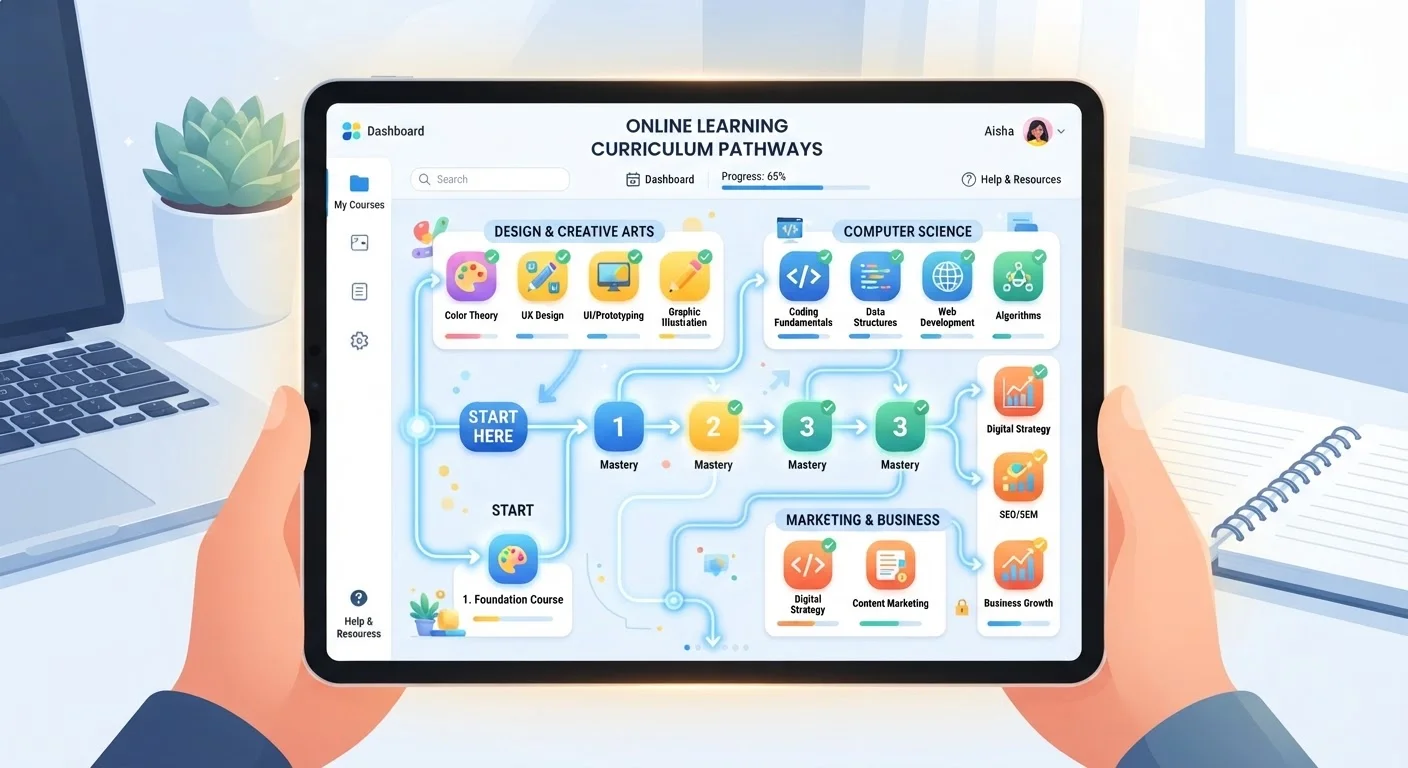
The Forces Behind What You See in a Free Catalog
When you open a free learning platform and browse its course catalog, the selection in front of you isn't accidental. Every subject listed - and every subject missing - reflects a set of deliberate choices made by editorial teams, business strategists, academic partners, and sometimes government funders. Understanding those forces makes you a sharper, more self-directed learner.
Three primary drivers shape most free platform curricula: learner demand signals, institutional and employer partnerships, and the platform's underlying revenue model. These forces often reinforce each other, but they can also pull in different directions - which is why you'll find an abundance of Python programming courses and a relative scarcity of, say, advanced labor law or regional dialects.
For a broader orientation to the free learning landscape, the Free Online Learning: A Complete Field Guide is a useful starting point before diving into how curriculum decisions get made.
220M+
Registered learners on major MOOC platforms globally
Class Central's annual MOOC reports have tracked sustained growth in free platform enrollment, reflecting how demand signals are generated at massive scale.
~60%
Free MOOC courses in tech and business subjects
Analyses of major open platform catalogs consistently find that technology and business topics dominate available free content relative to arts, humanities, and trades.
Hundreds
University partners on leading open platforms
Platforms like edX and Coursera list partnerships with hundreds of academic institutions, each of which influences which subjects and formats receive free catalog space.
Demand Signals: What Learners Search For
Most platforms track search queries, enrollment figures, and completion rates closely. When tens of thousands of users search for "machine learning for beginners" or "resume writing tips," that data feeds directly into content planning. High search volume for a topic often triggers new course development or the licensing of existing content from partner institutions.
This demand-driven approach has real benefits - platforms surface what large numbers of people genuinely want to learn. But it also creates a feedback loop. Popular subjects attract more courses, which attracts more learners, which reinforces the platform's investment in that area. Meanwhile, subjects with smaller but equally serious audiences - think archival studies, indigenous languages, or niche engineering subfields - may receive little or no free coverage.
This dynamic is worth keeping in mind when you explore subject areas where free online learning genuinely competes with formal education. Those are often fields where demand signals and employer interest happen to align strongly.
Partnerships and Revenue: The Hidden Curriculum Architects
Free platforms are rarely purely free to operate. Many generate revenue through premium certificates, employer hiring partnerships, or government workforce development grants. Each of these funding streams carries implicit curriculum preferences.
When a technology company co-develops a course with a platform, that content is typically well-resourced, prominently featured, and free to access - because the company benefits from a larger pipeline of trained candidates. When a government agency funds digital literacy courses, those programs reflect policy priorities around workforce readiness or social equity. Neither arrangement is inherently problematic, but both mean that curriculum is partly shaped by the interests of funders rather than purely by pedagogical goals.
University partnerships introduce a different kind of influence. Institutions that license their course materials to open platforms often prioritize content that reflects positively on their brand and faculty expertise. That can be genuinely valuable - but it also means that cutting-edge or interdisciplinary topics that don't fit neatly into a department's profile may be underrepresented.
“Open educational resources hold enormous promise, but what gets produced and distributed still reflects the priorities of those with the resources to create it - not simply the full range of what learners need.”
— Audrey Watters, Education technology critic and author of 'Teaching Machines'
If you're weighing how different major platforms balance these pressures, the comparison in LinkedIn Learning, Coursera, and edX: How the Major Platforms Actually Differ provides useful context on each platform's model and priorities.
What This Means for Your Learning Strategy
Recognizing that curriculum choices are shaped by market and institutional forces helps you use free platforms more strategically. Rather than assuming a catalog is comprehensive, treat it as one layer of a broader self-directed learning plan.
Check whether your target subject has strong coverage by searching across multiple platforms, not just one. For topics that are underserved - certain languages, for instance - purpose-built tools often outperform general platforms. Our look at what actually works for free language learning online illustrates how specialized resources can fill gaps that general catalogs leave open.
Also pay attention to recency and depth. A subject that was trending three years ago may have abundant free courses that are now outdated. Gaps in advanced or specialist content are common even in heavily covered fields - and those gaps often signal where free learning hits its natural ceiling.
Cross-Reference Multiple Platforms
If your subject area feels thinly covered on one free platform, search the same topic on two or three others before concluding the content doesn't exist. Different platforms have different partnership networks, which means coverage gaps on one are sometimes filled by another. University open courseware repositories - many freely available - are also worth checking for depth on academic subjects.
Free platforms are powerful tools when used with clear eyes. Knowing who shapes the curriculum - and why - gives you the context to supplement smartly and learn on your own terms.