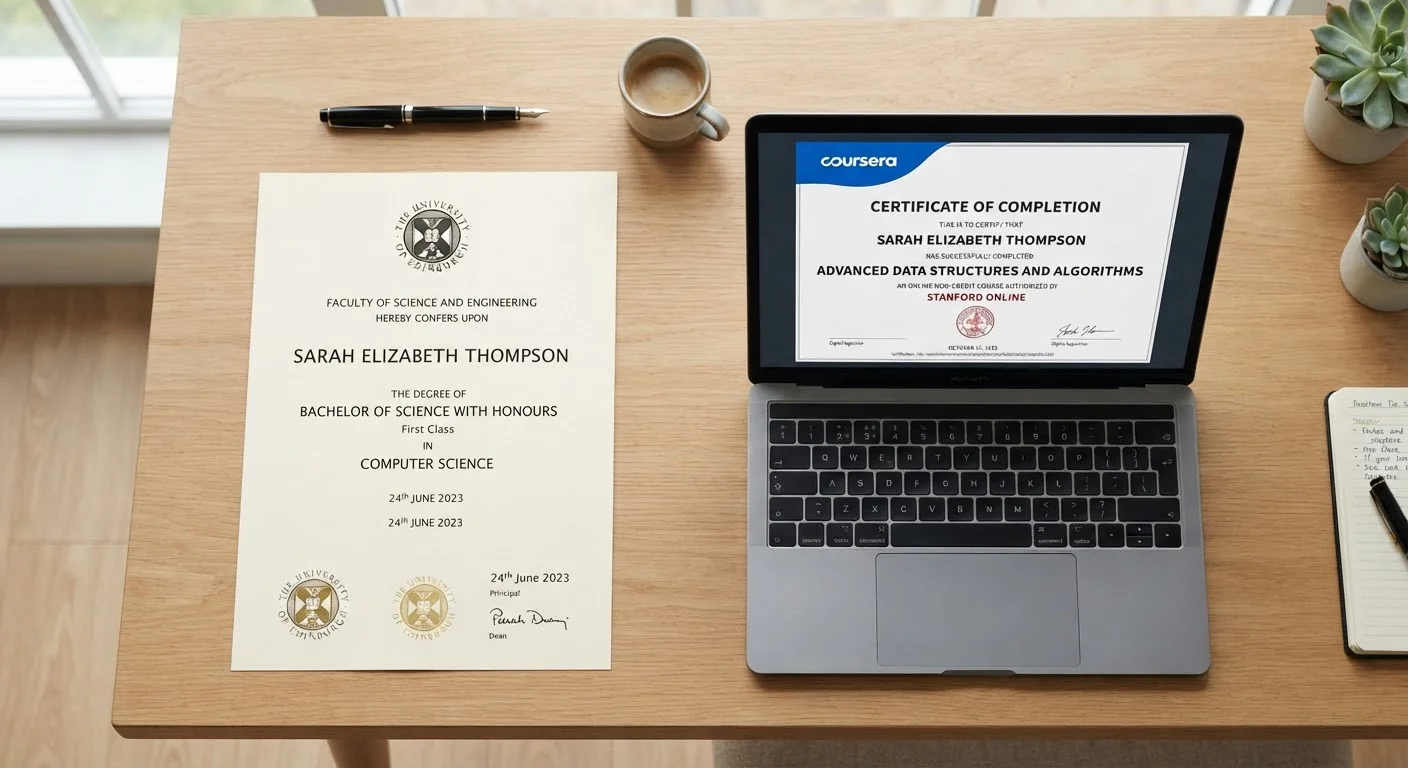
The Real Question: What Are Employers Screening For?
Before comparing credentials, it helps to understand what employers are actually looking for when they scan a resume. Hiring managers generally use credentials as a proxy for three things: demonstrated competence, capacity to complete structured learning, and professional credibility. A paid degree and a free certificate can each signal one or more of these qualities - but they do so in different ways and carry different weight depending on the industry.
In fields with strict regulatory requirements - healthcare, law, civil engineering - a relevant accredited degree is often a legal or licensing prerequisite. No certificate, free or paid, substitutes for it. But in fields like software development, UX design, data analytics, and digital marketing, many employers have publicly shifted toward skills-based hiring, evaluating candidates on what they can produce rather than where they studied. Understanding which camp your target industry falls into is the single most useful starting point. See our career skills fast hub for practical guidance on navigating this landscape.
How Free Certificates Are Perceived in Practice
Free certificates - issued by platforms offering MOOCs (Massive Open Online Courses) or open courseware - vary widely in their employer recognition. A certificate from a well-known platform delivering content from an accredited university tends to be viewed more favorably than a certificate from an obscure provider with no institutional backing. If you're unsure what distinguishes these credential types, our article on open courseware, MOOCs, and free certificates breaks down the key differences.
Employer surveys - including those conducted by LinkedIn and the Society for Human Resource Management - consistently suggest that verified skills demonstrations and portfolio work influence hiring decisions more than certificate format alone. A free certificate paired with a GitHub repository, published project, or case study portfolio speaks more loudly in a technical interview than a certificate in isolation.
| Free Certificate | Paid Degree | |
|---|---|---|
| Typical cost | $0 (audit) to ~$50 for verified credential | Thousands to tens of thousands of dollars |
| Accreditation | Usually none or platform-level only | Regional or national accreditation standard |
| Employer recognition (tech/digital fields) | High, especially with portfolio evidence | Moderate to high |
| Employer recognition (regulated fields) | Low - often insufficient alone | Required or strongly preferred |
| Time to complete | Days to several months | Two to four-plus years |
| Licensing eligibility | Generally not applicable | Often required for licensure exams |
| Alumni network access | Typically none | Institutional network included |
It's also worth noting that many free certificates are not fully equivalent to their paid counterparts on the same platform. Audit-mode access often omits graded assessments and the shareable credential itself - which is what employers can verify. For a deeper look at those distinctions, see our piece on free vs. paid online certifications.
Where Paid Degrees Still Hold a Clear Edge
A four-year or postgraduate degree from an accredited institution continues to provide advantages that free certificates generally cannot replicate. These include professional licensure eligibility, access to alumni networks, and a signal of long-term commitment that many traditional employers still interpret positively. In corporate environments with structured promotion ladders - finance, consulting, government - degree requirements are often written into job descriptions as non-negotiable filters.
There's also the matter of accreditation. Degrees from regionally or nationally accredited institutions meet standards verified by bodies recognized by the U.S. Department of Education. This matters when applying to graduate programs, federal positions, or roles that require professional board examinations. No free certificate currently replicates this standing.
That said, cost is a real factor. The value of a degree must be weighed against its total cost and the earning trajectory of your target role. This article offers general information - consult a qualified financial adviser or academic counselor before making major education investment decisions.
Presenting Credentials So Employers Actually Notice
Regardless of credential type, presentation consistently influences outcomes. A free certificate listed without context - just a title and a platform name - gives a recruiter little to evaluate. Framing your learning with the skills gained, projects completed, and problems solved transforms a line item into evidence of capability.
For actionable strategies on this, see our guide on making free learning count on your CV or LinkedIn profile. The same principle applies to micro-credentials, which sit in a middle ground between free certificates and full degrees - our explainer on micro-credentials and employer attention covers when they matter most.
Career changers in particular should review what evidence shows about fast certifications for career changers, since the impact of any credential depends heavily on how it fits your prior experience and the specific role you're targeting.
This article is for general informational and educational purposes only. It does not constitute financial, career, or academic advice. Readers should consult qualified professionals before making significant education or career investment decisions.