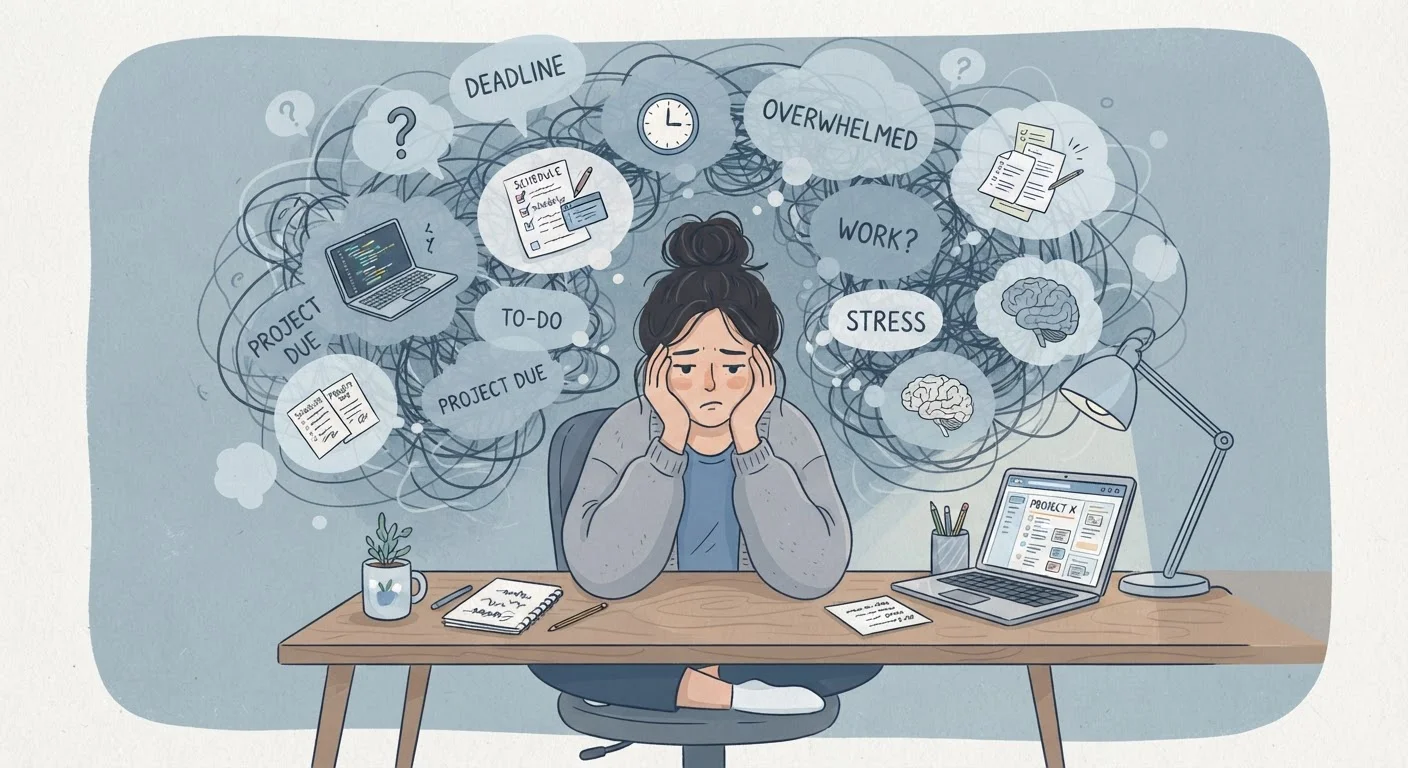
What Overthinking Actually Is (and Isn't)
Overthinking - also called rumination - is the habit of replaying thoughts, scenarios, or decisions in a loop without reaching resolution. It differs from productive reflection: genuine problem-solving moves toward a decision or an action, while rumination circles back repeatedly without progress. Cognitive behavioral research consistently links chronic rumination to elevated stress, disrupted sleep, and lower mood over time.
It's worth being clear: overthinking is not a sign of low intelligence or weakness. It often shows up in careful, conscientious people who place high value on getting things right. Understanding why the cycle starts is the first step toward changing it. For a broader look at how thought patterns interact with daily wellness habits, see Building a Personal Mental Wellness Toolkit from Scratch.
Why the Overthinking Cycle Is So Persistent
Rumination feels productive. When the brain is anxious, looping thoughts create an illusion of control - as though thinking harder will eventually produce the perfect solution or prevent a bad outcome. This feeling of mental effort makes the behavior self-reinforcing. Neuroscience research suggests the brain's default mode network, which is active during mind-wandering and self-referential thinking, is more strongly engaged in people who ruminate frequently.
Social and environmental factors add pressure. A culture that rewards preparation and worries about uncertainty can make it feel irresponsible not to keep analyzing. The result: a habit that serves short-term discomfort relief but increases long-term distress.
Trying to think your way out of overthinking by analyzing the problem more deeply.
Why it happens: It feels logical: if thinking caused the problem, better thinking should solve it. But rumination and analysis use overlapping mental resources, so more scrutiny usually means more loops.
Seeking constant reassurance from friends or online searches to quiet anxious thoughts.
Why it happens: Reassurance brings temporary relief, which feels rewarding. Over time, the brain learns to expect reassurance to feel okay, making the urge to seek it stronger.
Avoiding the situations or decisions that trigger overthinking.
Why it happens: Avoidance reliably reduces short-term distress, making it a go-to response. But it prevents the brain from learning that the feared outcome is manageable - reinforcing the sense of threat.
Treating every anxious thought as accurate information about the future.
Why it happens: The brain presents thoughts with a convincing feeling of truth, especially under stress. Distinguishing 'this is a thought' from 'this is a fact' requires deliberate practice.
Letting self-care routines collapse under the pressure of overthinking, then using that collapse as proof things are hopeless.
Why it happens: Rumination consumes cognitive bandwidth, making consistent habits harder to maintain. When routines slip, the overthinking brain often catastrophizes the lapse rather than treating it as normal.
Patterns That Actually Help
Breaking the overthinking cycle doesn't require radical life changes - it requires small, consistent interruptions. The following approaches are grounded in cognitive behavioral therapy (CBT) principles and are accessible without cost:
- Scheduled worry time: Set aside 15-20 minutes daily as designated thinking time. When a ruminating thought appears outside that window, note it and defer it. This technique, supported by clinical research, trains the brain to contain rather than amplify anxious loops.
- Behavioral activation: Physical movement - even a short walk - shifts attentional resources away from internal rumination. It doesn't require a gym membership or structured exercise plan.
- Written processing: Translating circular thoughts into written words forces structure onto them. Journaling for mental health is one of the most accessible tools for this, requiring nothing more than a notebook.
None of these strategies promise to eliminate worry. They're tools for reducing its intensity and frequency over time. And unlike approaches built on suppression or forced positivity, they work with the mind's natural processes rather than against them - a point explored in why positive thinking alone isn't enough.
This article is for general informational purposes only and is not a substitute for professional mental health advice. If overthinking is significantly affecting your daily functioning, please consult a qualified mental health professional.