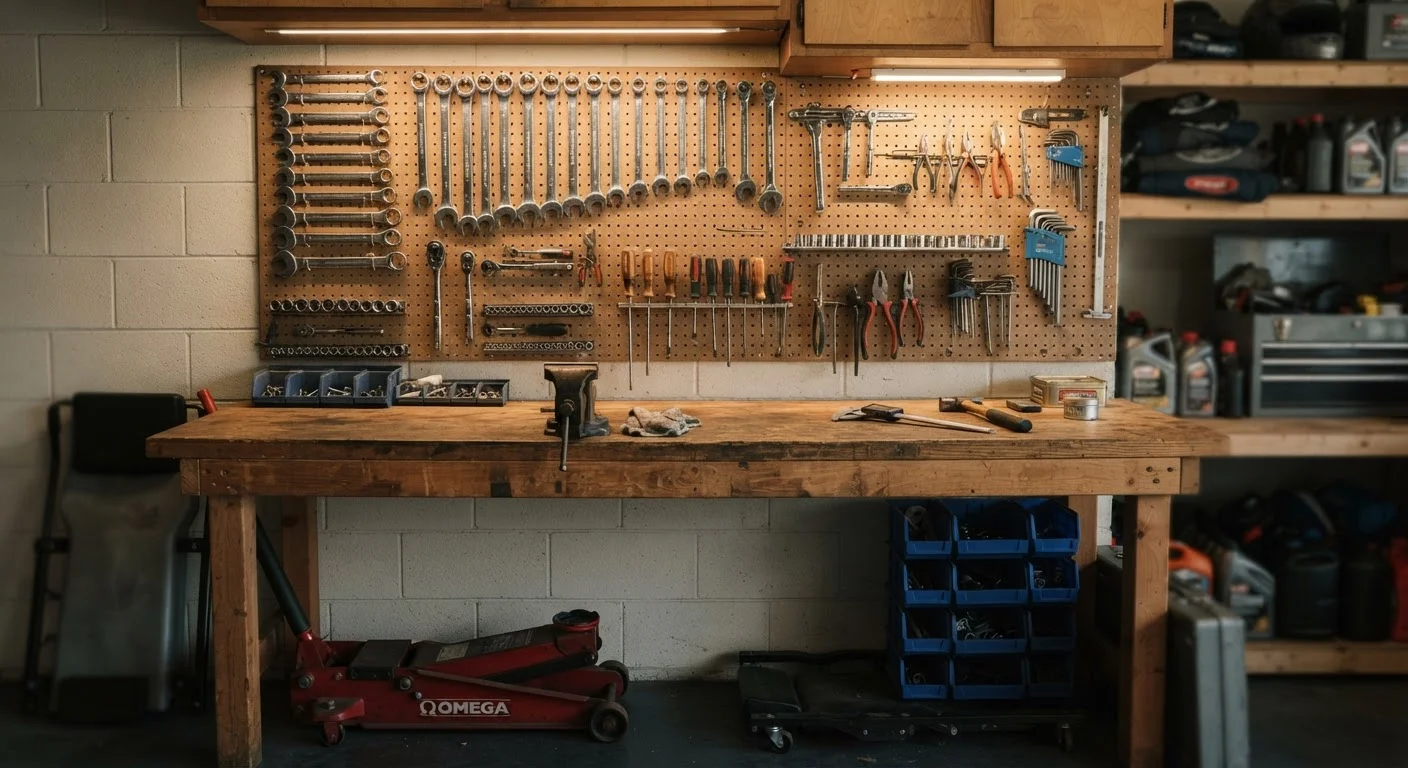
Why Building a Home Garage Kit Makes Sense
Labor often accounts for the majority of a repair bill at a professional shop. When a task is straightforward and safe to perform at home - an oil change, a cabin air filter swap, or a brake inspection - having the right tools means you can handle it yourself and pay only for parts. That's a meaningful difference for drivers managing a tight budget.
The catch is buying tools thoughtfully. A random assortment of mismatched hardware is frustrating to use and unlikely to cover your actual needs. The list below focuses on tools that appear repeatedly across common DIY jobs, making each purchase work for multiple situations. For a broader look at which maintenance tasks are worth prioritizing, see our car maintenance budget guide.
Socket Set with Ratchet (Metric and SAE)
A socket set is the single most-used collection of tools in automotive DIY work. Bolts on engine components, drain plugs, brake calipers, and suspension parts all require sockets in specific sizes. Modern vehicles in the US use a mix of metric and SAE (standard/imperial) fasteners depending on the manufacturer, so owning both sets prevents you from being caught short.
Look for a set that includes a 3/8-inch drive ratchet - versatile enough for most engine bay work - and a 1/2-inch drive for heavier tasks like lug nuts. Extension bars in the set allow you to reach recessed fasteners without contorting yourself.
A socket set with both metric and SAE coverage handles the widest range of fasteners on modern vehicles.
Combination Wrench Set
Combination wrenches - open-end on one side, box-end on the other - reach fasteners where a ratchet won't fit. Tight spots around the battery, fuel lines, and brake hardware frequently call for a wrench rather than a socket. Having a set that mirrors your socket range (again, both metric and SAE) keeps you covered.
Wrenches also double as a holding tool when you need to keep one bolt stationary while turning another - a common situation when working on brake calipers or fuel fittings.
Combination wrenches reach fasteners in tight spaces where a ratchet simply can't fit.
Floor Jack and Jack Stands
Any job that requires working under a vehicle - oil drain, brake inspection, suspension checks - demands that the vehicle be safely raised and supported. A hydraulic floor jack lifts the vehicle; jack stands hold it there safely. Never rely on a hydraulic jack alone to support a vehicle you're working under - hydraulic seals can fail.
A 2-ton floor jack and two matching jack stands handle most passenger cars and small trucks. Consult your vehicle's owner's manual for the correct jack points to avoid damaging the frame or rocker panels.
Jack stands are non-negotiable - never work under a vehicle supported only by a hydraulic jack.
Torque Wrench
A torque wrench lets you tighten fasteners to a specific measurement - expressed in foot-pounds or Newton-meters - rather than guessing by feel. Lug nuts, drain plugs, and cylinder head bolts all have manufacturer-specified torque values for good reason: under-tightening causes parts to loosen; over-tightening strips threads or warps components.
A click-type torque wrench in the 10-150 ft-lb range covers the majority of DIY tasks. Your vehicle's owner's manual or a service manual will list the torque specs you need.
Guessing torque by feel risks stripped threads or loose components - a torque wrench removes the guesswork.
Screwdriver Set (Flathead and Phillips)
Screwdrivers are used constantly for removing interior trim panels, battery terminals, air filter housings, and fuse box covers. A set that includes multiple shaft lengths and tip sizes in both flathead and Phillips styles covers the variety you'll encounter. Some vehicles also use Torx (star-shaped) fasteners on brake components and body panels, so adding a Torx bit set is worthwhile.
Insulated handles are a plus for any work near the battery or electrical system, though basic electrical safety - disconnecting the battery before certain jobs - is always the first step.
Multiple sizes and tip styles ensure you can reach and remove fasteners throughout the vehicle.
OBD-II Diagnostic Scanner
When a check engine light appears, an OBD-II scanner reads the stored fault codes that triggered it. Every vehicle sold in the US since 1996 has an OBD-II port, typically located under the dashboard near the steering column. A basic code reader tells you what the vehicle's computer flagged, which helps you decide whether the issue is something straightforward - like a loose gas cap - or something that warrants a shop visit.
Understanding the code before calling a mechanic also makes it harder to be charged for unrelated repairs. This is general information; interpreting fault codes for a specific repair decision may still require professional diagnosis.
Reading your own fault codes before visiting a shop helps you arrive informed and ask better questions.
Pliers Set (Including Needle-Nose)
Pliers handle tasks that fingers and wrenches can't: gripping rounded fasteners, pulling cotter pins, working with hose clamps, and managing wiring connectors. Needle-nose pliers are indispensable in tight engine bay spaces where standard pliers won't fit. Slip-joint pliers handle larger items like coolant hose clamps.
A set of locking pliers (commonly known by the Vise-Grip style) adds the ability to lock onto a stubborn or damaged fastener and apply steady rotational force - useful when standard tools can't get purchase.
Needle-nose pliers reach into tight engine bay spaces that fingers and larger tools simply cannot access.
Work Light or LED Headlamp
Engine bays and undersides of vehicles are poorly lit even in a bright garage. A focused work light - or an LED headlamp worn on your head - makes it possible to see exactly what you're doing without holding a flashlight in your teeth. Poor visibility leads to mistakes: wrong fasteners, missed connections, and tools dropped into inaccessible spots.
A rechargeable LED work light is compact, bright, and lasts for hours on a charge. Some models include a magnetic base that sticks to metal surfaces, freeing both hands for the actual work.
Adequate lighting prevents costly mistakes; poor visibility in an engine bay is a frequent source of errors.
Building Smart, Not Just Big
You don't need a professional-grade shop to handle meaningful DIY maintenance. The tools above, assembled gradually as needs arise, form a practical foundation that pays for itself relatively quickly. Skipping small maintenance tasks because you lack tools is also a real cost - one that compounds over time. Our article on why deferred maintenance gets expensive explains that dynamic clearly.
Add Tools Gradually as Jobs Arise
Rather than buying every tool at once, consider acquiring items when a specific job requires them. This approach means every tool you own earns its place immediately and you're not spending on items that sit unused. Starting with the socket set, jack stands, and a screwdriver set covers the widest range of entry-level tasks.
Store tools in a lockable metal chest or cabinet - moisture and disorganization shorten tool lifespan and create safety hazards. This is general educational information; always consult your vehicle's owner's manual and, when a job exceeds your comfort level or requires specialized knowledge, have a qualified mechanic take over.