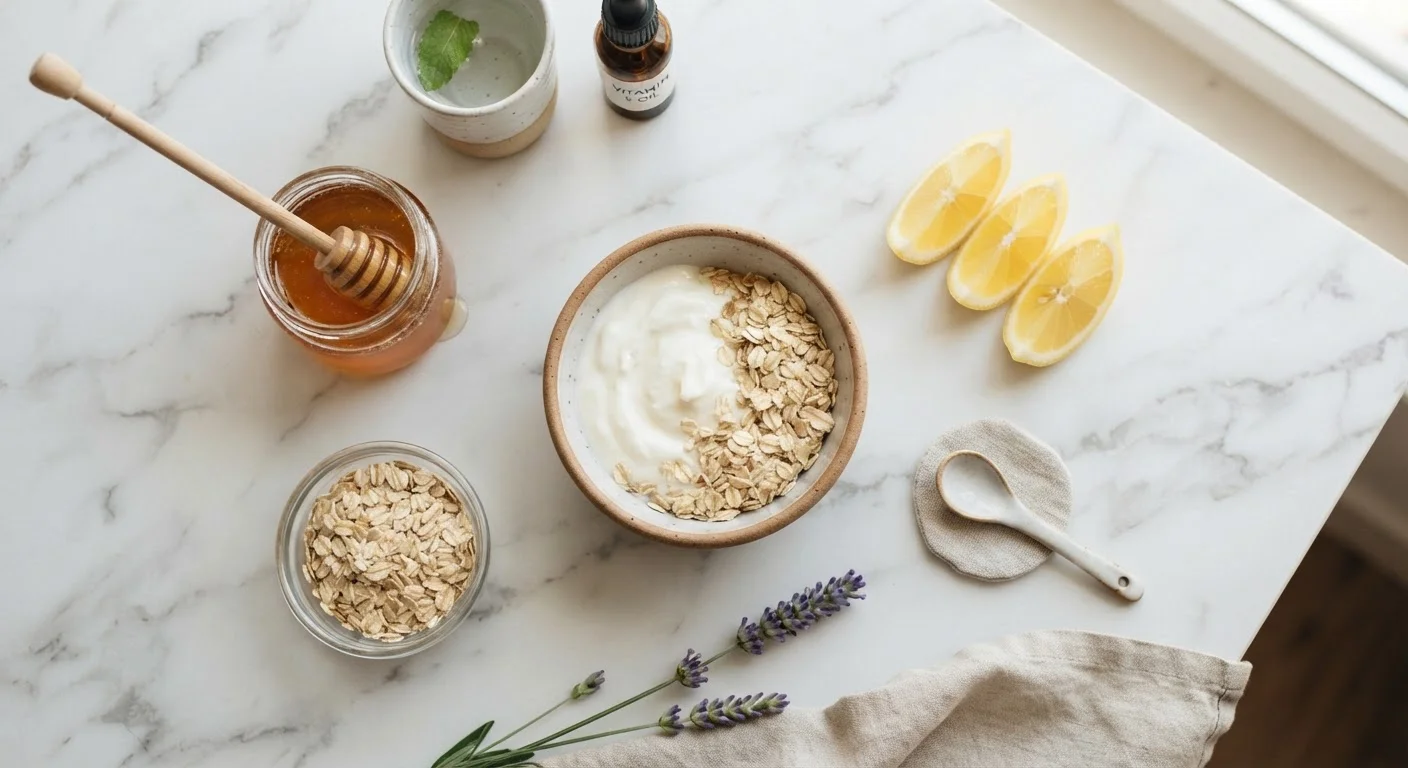
Why Kitchen Skincare Has Such Staying Power
The appeal of raiding the pantry for a face mask is easy to understand: the ingredients are familiar, inexpensive, and feel wholesome. Social media has accelerated the trend, with tutorials promising glowing skin from ingredients you already own. But enthusiasm often outpaces evidence, and some widely shared DIY recipes can actually harm skin rather than help it.
This article works through the most commonly recommended kitchen ingredients - honey, oats, yoghurt, lemon, and baking soda - and weighs each against what dermatology research actually says. For a broader look at low-cost wellness habits that hold up under scrutiny, see habits research actually supports.
Myth
Raw honey is just a folk remedy with no real skincare benefit.
Fact
Honey has documented antimicrobial and humectant (moisture-attracting) properties that are recognized in dermatology literature.
Raw honey contains hydrogen peroxide, bee defensin-1, and a low pH - all of which contribute to its antimicrobial activity. Studies on medical-grade honey (such as Manuka) show effectiveness in wound healing and reducing certain bacterial populations on skin. As a humectant, honey draws water toward the skin surface, which can support temporary hydration. That said, most research uses standardized medical formulations, not off-the-shelf grocery honey. Using raw honey as an occasional gentle mask is low-risk for most people, but it is not a treatment for acne or infection.
Myth
Lemon juice brightens skin and fades dark spots naturally and safely.
Fact
Lemon juice is strongly acidic and phototoxic, and applying it to skin can cause burns, irritation, and worsened pigmentation.
Lemon juice has a pH of around 2 - far below skin's healthy range of 4.5 to 5.5. Applying it directly disrupts the acid mantle (the skin's protective surface layer), causing dryness, redness, and increased sensitivity. It also contains psoralens, compounds that react with UV light and can cause a chemical burn known as phytophotodermatitis. Dermatologists widely advise against using undiluted citrus on skin. For hyperpigmentation concerns, formulations containing niacinamide or azelaic acid have far stronger safety and efficacy evidence.
Myth
Colloidal oats are just marketing hype - plain oatmeal does the same thing.
Fact
Colloidal oatmeal is a specifically processed, finely milled form that the FDA recognizes as an over-the-counter skin protectant; plain oatmeal is not equivalent.
Colloidal oatmeal is oat grain ground to a fine powder and suspended in liquid. This processing maximizes the availability of avenanthramides - anti-inflammatory compounds - and beta-glucan, which forms a protective film on skin. The FDA classified colloidal oatmeal as a Category I skin protectant in 2003. Studies support its use in reducing itch and irritation associated with eczema and dry skin. A rough oatmeal paste made from kitchen oats is not the same product: particle size and compound concentration differ significantly. A fine oat powder rinsed quickly in lukewarm water is closer to the therapeutic form and is generally safe for sensitive skin.
Myth
Baking soda makes a great exfoliant and helps balance oily skin.
Fact
Baking soda is highly alkaline and can seriously damage the skin barrier, making skin more prone to breakouts and irritation.
Baking soda has a pH of approximately 9, which is far outside the healthy range for skin. Applying it disrupts the acid mantle, strips natural oils, and can cause micro-tears. Counterintuitively, this often triggers increased oil production as the skin tries to compensate - worsening the oiliness it was meant to treat. Dermatologists consistently advise against using baking soda as a facial product. For gentle physical exfoliation, products formulated to a skin-compatible pH are a safer alternative.
Myth
Plain yoghurt applied to skin acts like a professional lactic acid peel.
Fact
Yoghurt does contain lactic acid, but at concentrations too low and too variable to replicate clinical exfoliation treatments.
Lactic acid is an alpha-hydroxy acid (AHA) used in dermatology to promote cell turnover and improve skin texture. Plain yoghurt does contain lactic acid produced during fermentation. However, the concentration in yoghurt is inconsistent and generally well below the levels used in clinical exfoliants (which typically range from 5% to 10%). A yoghurt mask may provide a mild, temporary smoothing effect and the moisturizing benefit of its fat content, but it should not be expected to produce the same results as a formulated AHA product. It is low-risk for most people with no known dairy allergy.
What the Evidence Supports - and What to Avoid
The clearest pattern in the research is that ingredients already used in clinical or pharmaceutical formulations tend to have the strongest evidence. Colloidal oatmeal, for example, is an FDA-recognized skin protectant, and medical-grade honey has been studied for wound care. That doesn't mean a quick oat paste provides the same effect as a standardized formulation - concentration, particle size, and application method all matter.
2003
Year FDA recognized colloidal oatmeal as a skin protectant
The U.S. Food and Drug Administration classified colloidal oatmeal as a Category I over-the-counter skin protectant in its monograph system.
4.5-5.5
Healthy skin surface pH range
Research published in dermatology literature consistently identifies this narrow pH range as optimal for maintaining the skin's protective acid mantle.
~pH 2
Approximate pH of lemon juice
This acidity is dramatically lower than healthy skin pH, which is why dermatologists warn against applying undiluted citrus juice directly to the face.
On the other hand, ingredients whose popularity rests mainly on tradition or anecdote - raw lemon juice, baking soda, toothpaste - carry real risks. Skin's average surface pH sits around 4.5 to 5.5; both baking soda (highly alkaline) and undiluted lemon juice (strongly acidic) can disrupt this balance, weaken the barrier, and make skin more vulnerable to irritation and infection.
For more on reading ingredient claims critically, the spa-day-at-home guide covers DIY treatments across a wider range of self-care rituals. And if you want foundational knowledge on how substances interact with the body, nutrition terms glossary explains concepts like bioavailability that are relevant to topical absorption too.
The practical takeaway: treat kitchen ingredients as low-risk supplements to a basic routine - cleanser, moisturizer, sunscreen - rather than replacements for it. Always patch-test a new ingredient on your inner forearm for 24 hours before applying it to your face, and discontinue use if you notice redness, stinging, or swelling. For persistent skin concerns, consult a licensed dermatologist rather than experimenting with home remedies.
This article is for general informational purposes only and does not constitute medical or dermatological advice. Consult a qualified healthcare professional for concerns about your skin health.